 blog
blog
Custom vs Stock Kitchen Cabinets: A 2026 Guide
Table of Contents
- Custom vs Stock Kitchen Cabinets: Understanding Your Options
- Stock Cabinets: Speed and Affordability
- Semi-Custom Kitchen Cabinets: The Middle Ground
- Custom Cabinetry: Unlimited Design Flexibility
- Kitchen Cabinet Lead Times: What to Expect
- Average Kitchen Remodel Budget: Planning Your Investment
- Making Your Choice: Custom, Semi-Custom, or Stock
- Conclusion
- Frequently Asked Questions
Last Updated: September 30, 2026
Custom vs Stock Kitchen Cabinets: Understanding Your Options
When planning a kitchen remodel, the choice between custom vs stock kitchen cabinets involves more than price, it affects lead times, design flexibility, material quality, and how your kitchen functions for 10 to 20 years.
Stock cabinets arrive in standard dimensions. Semi-custom cabinets offer some personalization within a set framework. Custom cabinetry lets you design exactly what you need. Each option has real trade-offs that matter for your timeline, budget, and vision.
This guide breaks down the differences, costs, and timelines to help you avoid expensive mistakes.
Stock Cabinets: Speed and Affordability
Stock kitchen cabinets are mass-produced in standard sizes and finishes, with a limited selection of 5 to 15 door styles, colors, and hardware options per manufacturer.
Stock cabinets offer lower cost and fast delivery, typically 2 to 4 weeks, making them ideal for tight budgets or timelines.
Standard dimensions force compromises: odd angles, unusual wall heights, or specific storage needs result in filler panels, wasted space, or mismatched vision.
Stock cabinets often use particle board or lower-grade plywood, basic hinges without soft-close features, and simpler drawer construction.
Pros:
- Lowest upfront cost
- Fastest lead time (2-4 weeks)
- Immediate availability
- Minimal design consultation needed
Cons:
- Limited design options and finishes
- Standard dimensions may not fit your space
- Lower-quality materials and construction
- Less durable hardware
- No customization for specific storage needs
Semi-Custom Kitchen Cabinets: The Middle Ground
Semi-custom kitchen cabinets offer a broader range of sizes, styles, finishes, and hardware than stock, but within a predetermined modular system.
Lead times run 6 to 12 weeks, with design collaboration to navigate available options.
Semi-custom cabinets offer real personalization without the cost or timeline burden of full custom work, letting you choose styles, finishes, and storage configurations that match your needs.
Semi-custom cabinets use plywood, soft-close hinges, and dovetail drawers as standard, offering noticeably better durability and functionality than stock.
The trade-off is flexibility, unusual dimensions or custom solutions may not be possible within the manufacturer's standard configurations.
Pros:
- Moderate cost (between stock and custom)
- Reasonable lead time (6-12 weeks)
- Extensive design options
- Better materials than stock cabinets
- More personalization than stock
Cons:
- Limited to manufacturer's size and style options
- Can't customize for unusual spaces
- Longer wait than stock
- Less flexibility than true custom
Custom Cabinetry: Unlimited Design Flexibility
Custom cabinetry is built to your exact specifications with no standard sizes, predetermined options, or compromises.
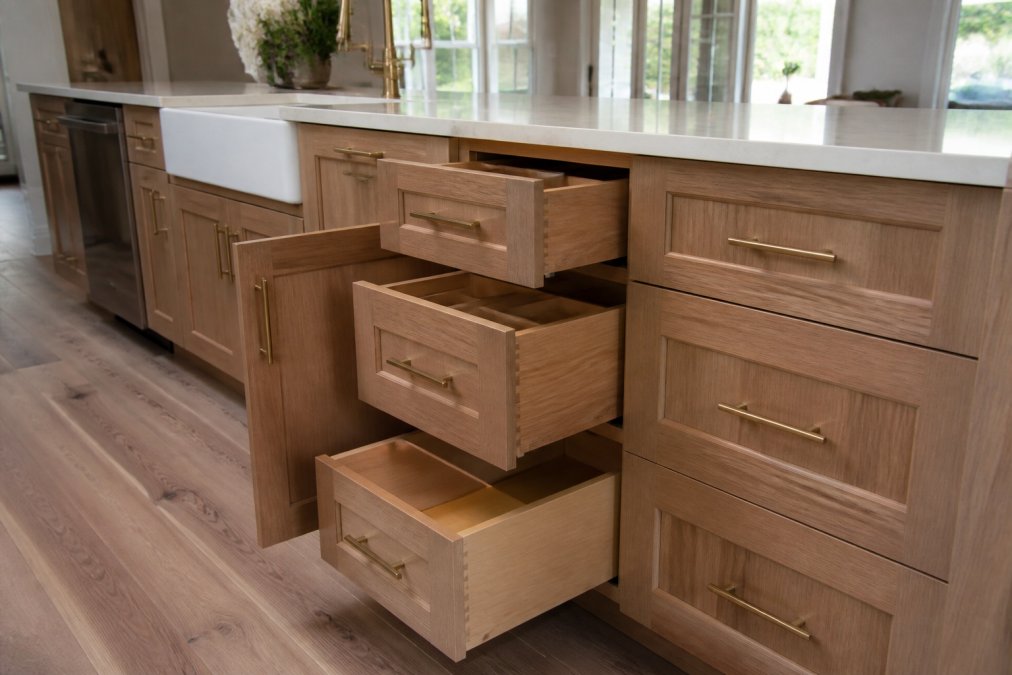
Custom cabinets solve real problems: angled walls, specific storage configurations, and premium materials like solid wood with hand-applied finishes.
Lead times are typically 10 to 16 weeks, reflecting the detailed measurements, design iterations, and careful construction required.
Upfront costs are higher, but custom cabinets last longer and function better because they're built for your specific space and needs.
Custom cabinets use solid wood or premium plywood with dovetail or mortise-and-tenon joinery, soft-close hinges, and premium hardware as standard.
Pros:
- Unlimited design flexibility
- Fits any kitchen layout or space
- Premium materials and construction
- Personalized storage solutions
- Better long-term durability
- Higher resale value impact
Cons:
Click and Make your "IN-STORE" appt today! →
- Highest upfront cost
- Longest lead time (10-16 weeks)
- Requires detailed design consultation
- More complex installation process
Kitchen Cabinet Lead Times: What to Expect
Lead time, the gap between order and installation, determines when your kitchen renovation actually happens.
Stock cabinets typically arrive in 2 to 4 weeks, though less common finishes or configurations can stretch to 6 to 8 weeks.
Semi-custom kitchen cabinets average 6 to 12 weeks, with most orders arriving in 8 to 10 weeks, a predictable timeline for planning.
Custom cabinetry requires 10 to 16 weeks from order to delivery, including design (2-3 weeks), production (4-8 weeks), and finishing (2-3 weeks).
If you need cabinets in 8 weeks, stock or semi-custom are your only options. With 5 months, custom becomes feasible.
Average Kitchen Remodel Budget: Planning Your Investment
Cabinetry typically represents 30 to 40 percent of a full kitchen renovation budget, with the rest going to countertops, appliances, flooring, and labor.
For a modest remodel, cabinetry costs vary, with stock at the lower end and custom at the higher end.
For a more comprehensive renovation with new appliances, countertops, flooring, and layout changes, cabinet investment typically grows.
The Total Cost of Ownership: Beyond Upfront Price
The key insight is not to view cabinet cost in isolation, instead, evaluate the total cost of ownership over the cabinet's lifespan. Cabinetry lasts 15 to 25 years. Countertops may need replacement in 10 to 15 years. Appliances typically last 10 to 12 years. Cabinets outlast almost everything else in your kitchen, which means they disproportionately affect your long-term satisfaction and actual cost per year of use.
Stock cabinets have a lower upfront cost but higher maintenance and replacement costs over time. Particle board and lower-grade plywood are prone to warping, water damage, and sagging shelves.
Resale Value and Market Appeal
Kitchens with custom or high-quality semi-custom cabinetry tend to appeal more to buyers and command higher perceived value. While you won't recover the full cabinet cost at resale, better cabinets do improve marketability and buyer confidence. Homes with visibly worn or damaged stock cabinets often require negotiation on price or face longer time on market. A kitchen with well-maintained semi-custom or custom cabinetry is a strong selling point that can offset some of the higher upfront investment.
Making Your Choice: Custom, Semi-Custom, or Stock
The decision comes down to five key factors: timeline, budget, kitchen layout complexity, long-term plans, and maintenance tolerance.
Timeline Constraints
Timeline pressure often decides the issue first. A 6-week kitchen remodel demands stock cabinets, semi-custom and custom simply cannot deliver in that window. A 12-week project opens semi-custom options. A 5-month renovation allows custom work. If you're working backward from a hard deadline (moving, seasonal home use, contractor availability), this factor may eliminate options before you even consider design or budget.
Layout Complexity and Space Constraints
If your kitchen layout is standard with typical wall heights and right angles, stock or semi-custom work fine. If your space has unusual dimensions, sloped ceilings, odd angles, or specific storage needs that stock options don't address, semi-custom or custom becomes necessary. A kitchen with a 7-foot ceiling in one corner, an angled soffit, or a corner that doesn't form a 90-degree angle cannot be solved with stock cabinets without visible gaps, filler panels, or wasted space.
Budget Constraints and Value Alignment
Budget constraints matter, but they're not always what they seem. A homeowner with a $25,000 total budget might choose stock to stay within limits. But that same homeowner might spend $20,000 on a semi-custom solution that delivers better functionality, durability, and resale appeal. The total investment is higher, but the value per dollar and longevity are proportionally better. Consider your budget as a range, not a hard ceiling, and evaluate the cost-per-year-of-use rather than just upfront price.
Long-Term Plans and Maintenance Tolerance
Consider your long-term plans and how much maintenance you're willing to perform. If you're planning to stay in your home for 10 years or more, investing in semi-custom or custom cabinetry makes sense because you'll benefit from the durability, functionality, and lower maintenance costs. If you're likely to move within 5 years, stock cabinets that meet basic needs are reasonable, you won't be there long enough to experience major wear.
The Hybrid Approach: Customizing Stock Cabinets
A practical middle ground exists that many homeowners overlook: customizing stock or semi-custom cabinets to bridge the gap between cost and personalization. You can purchase stock cabinets and add custom hardware (soft-close hinges, premium pulls, specialty knobs), apply custom paint or stain finishes, add custom trim or crown molding, or install custom interior organizers and pull-out systems. This approach costs more than basic stock but far less than full custom cabinetry, and it delivers significant personalization and improved functionality.
Decision Framework
Choose stock if: You need cabinets in 4-6 weeks, your kitchen layout is standard, your budget is under $8,000 for cabinetry, and you're comfortable with basic finishes and standard storage.
Conclusion
Choosing between custom vs stock kitchen cabinets isn't really about picking the "best" option. It's about matching the right solution to your specific situation. Stock cabinets solve the speed and budget problem. Semi-custom cabinetry delivers personalization without excessive cost or wait time. Custom work handles complex spaces and creates exactly what you envision.
Frequently Asked Questions
What are the primary differences between stock, semi-custom, and custom cabinets?
Stock cabinets come in standard dimensions and finishes from big-box stores, ready for immediate installation. Semi-custom cabinets offer limited personalization within preset configurations, with moderate lead times. Custom cabinetry is built to your exact specifications, allowing full design flexibility in dimensions, materials, door styles, hardware, and finishes. Each option differs in cabinet box construction quality, finish durability, and aesthetic customization possibilities. Your choice depends on your budget, timeline, and how much your kitchen's layout requires tailored solutions.
How do lead times compare between stock and custom cabinetry?
Stock cabinets are typically available immediately or within 1-2 weeks, making them ideal for fast renovation timelines. Semi-custom kitchen cabinets usually have lead times of 4-8 weeks, depending on the manufacturer and customization level. Custom cabinetry typically requires 8-16 weeks or longer, as each piece is built to order. Kitchen cabinet lead times also depend on current factory demand and material availability. If your renovation timeline is tight, stock or semi-custom options may be necessary. For projects with flexibility, custom options allow more thoughtful design choices.
Is it worth it to get custom kitchen cabinets?
Custom cabinets justify the investment if your kitchen has unusual dimensions, you need specific storage solutions, or you want superior construction standards like dovetail drawers and soft-close hinges. They offer better resale value impact and long-term durability compared to stock alternatives. However, if your space uses standard dimensions and your budget is limited, semi-custom or stock cabinets may deliver good value. Consider your renovation timeline, maintenance preferences, and how long you plan to stay in your home when evaluating custom versus semi-custom options.
What factors influence the average kitchen remodel budget?
Your average kitchen remodel budget depends on cabinet type, material quality (particle board versus plywood construction), countertop selection, installation labor costs, and whether you're upgrading appliances or plumbing. Cabinetry typically represents 30-40% of total kitchen remodel costs. Additional factors include hardware compatibility, whether you need structural modifications for space optimization, and your finish preferences. Working with a designer who offers 3D visualization helps you allocate your budget effectively across all components before construction begins.