 how-to
How to Get Custom Kitchen Cabinetry Quotes: 2026 Guide
Table of Contents
- What to Know Before You Request a Custom Kitchen Cabinetry Quote
- Your Custom Cabinet Quote Checklist: What to Prepare
- Questions to Ask a Cabinet Maker Before You Sign
- Kitchen Cabinet Quote Comparison: A Side-by-Side Worksheet
- Custom Cabinet Project Timeline: From Quote to Installation
- Quote Red Flags and Contract Protections to Watch For
- Frequently Asked Questions
Last Updated: October 6, 2026
What to Know Before You Request a Custom Kitchen Cabinetry Quote
A custom kitchen cabinetry quote is a written, itemized estimate covering the cost of designing, building, delivering, and installing cabinets made to fit your space. At My Kitchen Design EXPO, we have watched homeowners walk into showrooms with a rough idea and walk out with three wildly different numbers.
Understand this first: you are not comparing prices. You are comparing what each cabinet maker included, left out, and assumed you already knew.
Before you request a single quote, decide which tier of cabinetry you actually need.
Custom vs. Semi-Custom vs. Stock vs. Refacing
Custom cabinetry is built to your exact dimensions, layout, and finish specifications, fitting odd corners, sloped ceilings, and non-standard wall spans without filler strips, but it is much more expensive and the process of building and installing the cabinets will take months
Semi-custom cabinets come in standard sizes but allow choices in finish, door style, and interior options, flexibility without full fabrication.
Stock cabinets are pre-made in fixed sizes and depths: fastest and least expensive
Refacing keeps your existing boxes and replaces only doors, drawer fronts, and veneer. This option can be more expensive than the stock cabinets and will take longer time to finish the job
Your Custom Cabinet Quote Checklist: What to Prepare
Most homeowners lose two to three weeks by requesting quotes before they have a complete package. Cabinet makers quote faster and more accurately when you hand them everything on day one, and when every shop receives the same information, the estimates are actually comparable.
The Quote-Request Package
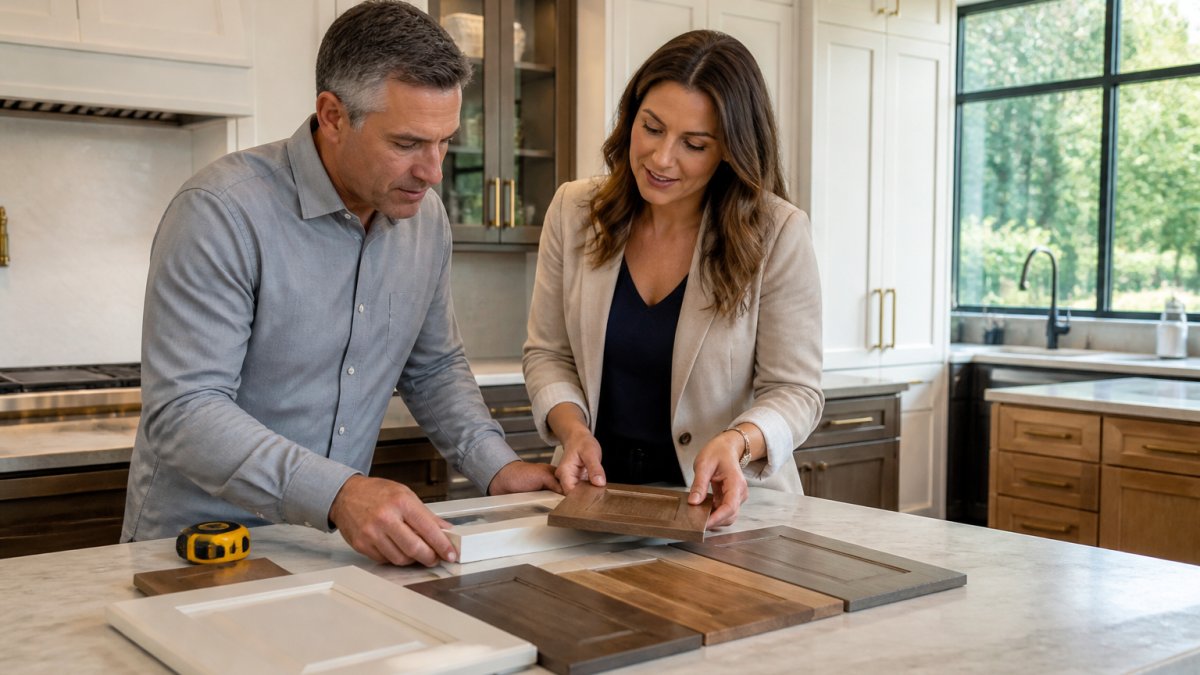
Gather these before you contact anyone. Send the identical package to every shop you approach.
- Room measurements: wall lengths, ceiling height, window and door positions, and the distance from the sink to the range
- Photos of the current kitchen from every corner and straight-on at each wall
- A rough sketch or layout idea, even hand-drawn, marked with what you want to keep and what you want to move
- Appliance list with model numbers and dimensions; the range, refrigerator, dishwasher, hood, and microwave all set the clearances the cabinet maker must design around
- Your must-haves: island, pantry pull-outs, trash cabinet, deep drawers, tray dividers
- Your budget range, stated honestly; a shop that knows your ceiling can propose a realistic tier instead of quoting a number you will reject.
- Your target start date and how long you can live without a working kitchen
Why Each Item Changes the Number
Measurements and photos determine whether the shop prices filler strips, scribe molding, or a custom-sized cabinet for an out-of-square wall. Appliance model numbers determine whether a refrigerator needs a surround panel and whether the range hood requires a taller upper cabinet.
A common pattern is that the lowest bid comes from the shop that received the least information. It is not cheaper; it is priced against assumptions that will change once the shop sees the room.
Measurements, Photos, and Layout Details
You do not need millimeter precision, but you do need to be close. Note the sink-to-range distance, counter depth, and whether the ceiling drops near the soffit. Photos catch what measurements miss: outlets, vents, radiators, and how light falls across the room.
If your kitchen is small or oddly shaped, say so upfront. A cabinet maker who specializes in tight layouts will quote it differently than one who mostly builds large islands
Questions to Ask a Cabinet Maker Before You Sign
Ask about box construction first. Cabinet boxes are built from plywood, particleboard, or medium-density fiberboard, and the material affects how long cabinets hold their shape in a humid climate.
Then move to hardware. Ask whether the quote includes soft-close slides and hinges or treats them as upgrades, and about full-extension drawers versus standard slides that leave the rear third inaccessible.
Other questions worth asking:
- Who measures the space, you or a trained technician?
- Is the custom design drawn before or after you pay a deposit?
- What is the project timeline from order approval to installation?
- Who handles plumbing and electrical if the layout changes?
- Can you speak to a recent customer with a similar kitchen?
Materials, Finishes, and Construction Quality
Cabinet materials range from plywood and solid wood to particleboard and MDF. Solid wood doors look premium but expand and contract with humidity; MDF takes paint smoothly and resists warping; plywood boxes outperform particleboard in wet areas.
Click and Make your "IN-STORE" appt today! →
Cabinet finish options include stain, paint, laminate, and thermofoil. Paint shows scratches but touches up easily; laminate resists moisture but cannot be refinished later.
Drawers, Hardware, and Storage Features
Custom inserts for cutlery, spices, and recycling bins turn dead space into usable storage. Storage solutions like pull-out pantries, corner carousels, and toe-kick drawers add cost but change how the kitchen functions. Premium hardware is worth the upgrade if you use your kitchen daily.
Kitchen Cabinet Quote Comparison: A Side-by-Side Worksheet
Comparing quotes line by line is the only way to know you are comparing the same project. Use this worksheet to normalize every quote.
Comparison Item | Quote A | Quote B | Quote C |
|---|---|---|---|
Total price | |||
Cabinet box material | |||
Door style and finish | |||
Soft-close hardware included | |||
Full-extension drawers | |||
Delivery included | |||
Installation labor included | |||
Countertops included | |||
project timeline | |||
Warranty length | |||
Fill in each column as you read the quote. Any blank cell is a question to ask before you sign. A quote that looks cheaper often has three empty rows.
Custom Cabinet Project Timeline: From Quote to Installation
A custom cabinet project moves through six stages, but the calendar is not evenly divided. Most elapsed time happens during design approval and fabrication; understanding where the weeks go lets you set a realistic start date and hold a shop to a schedule.
- Consultation and measurement: a designer visits, measures, and discusses layout
- Design and 3D rendering: you review the layout before anything is built
- Quote review and order approval: you sign off on the itemized design
- Fabrication: the shop builds your cabinets to spec
- Delivery: cabinets arrive on site and start the installation
- Installation: the cabinet installer sets, levels, and trims the boxes and makes them ready for inspection
Where the Weeks Actually Go
Design and revision is the stage homeowners most often underestimate. Every round of changes, moving a drawer bank, swapping a door style, resizing an island, restarts part of the drawing work.
Fabrication is usually the longest single stage, since custom cabinets are built to your dimensions rather than pulled from a shelf.
Delivery and installation are comparatively short but most likely to slip for reasons outside the cabinet maker's control, a countertop template waiting on cabinets, an unfinished electrical rough-in, or an unlevel floor.
Sequencing With the Other Trades
Cabinets are rarely the only trade in the room. A realistic schedule accounts for the order of operations:
- Demolition and any wall or plumbing changes happen before cabinets are installed, because a moved sink changes the cabinet layout
- Electrical and plumbing rough-in must be inspected and closed up before cabinet installation
- Countertop templating happens after base cabinets are set and leveled, which adds a separate lead time between installation and a usable kitchen
- Flooring is often installed before cabinets, but not always; confirm the sequence with the designer or the installer
What to Put in Writing
Ask for a written schedule with each stage dated, not a vague completion window. It should name the approval date that starts fabrication, the expected delivery window, and installation dates, plus what happens if materials are delayed and who reschedules the other trades.
Quote Red Flags and Contract Protections to Watch For
Warning signs:
- A large deposit demanded before any design work is shown
- No written timeline or completion date
- No warranty terms in writing
- A price that changes after the contract is signed
- No named point of contact for the project
Protect yourself with a written contract stating the scope of work, payment schedule, completion date, and warranty.
Getting custom kitchen cabinetry quotes is not about finding the lowest number. It is about finding the quote that tells you the truth about scope, materials, and timeline before you commit.
Frequently Asked Questions
What information do I need to get a custom kitchen cabinet quote?
Gather accurate room measurements, photos of your current kitchen layout, a rough sketch of your ideal layout, and a list of must-have features like soft-close slides, full-extension drawers, or custom inserts. Also note your preferred cabinet materials, finish, and whether you want matching countertops. The more detail you provide upfront, the more accurate and comparable your custom kitchen cabinetry quotes will be.
How many quotes should I get for custom kitchen cabinets?
Getting three to four quotes gives you a reliable picture of fair market pricing without overwhelming your decision. Fewer than three makes it hard to spot outliers, while more than four rarely adds new information. Focus on comparing itemized costs, scope of work, and included services like delivery and installation rather than chasing the lowest number.
What should a custom cabinet quote include?
A thorough quote should break down cabinet pricing by unit or linear foot, list cabinet materials and finish, specify hardware such as soft-close slides and full-extension drawers, and separate installation labor from product cost. It should also state whether delivery, countertops, and any built-in or custom design work are included. Ask for an itemized quote so you can compare line by line.
Is a custom cabinet quote binding?
Most quotes are estimates, not binding contracts. A quote typically becomes binding once both parties sign a formal agreement that locks in the scope of work, materials, and price. Before signing, confirm what happens if material costs change, how change orders are handled, and what the cancellation policy is. Get any verbal promises in writing.
How long does it take to receive a custom kitchen cabinet quote?
Simple quotes can come back in a few days, while detailed custom designs with 3D renderings often take one to two weeks. The custom cabinet project timeline depends on design complexity, material availability, and how quickly you provide measurements and approvals. Ask the cabinet maker for a realistic turnaround before you commit.