 ultimate-guide
Quartz Countertop Maintenance Guide 2026
Table of Contents
- Quartz Countertop Maintenance: What Every Owner Should Know
- How to Clean Quartz Countertops Daily
- Best Cleaner for Quartz Countertops: What Works and What to Avoid
- How to Remove Stains from Quartz Countertops
- Quartz Countertop Heat Resistance and Damage Prevention
- Finish-Specific Care: Polished vs Honed Quartz
- A Simple Quartz Countertop Maintenance Schedule
- Frequently Asked Questions
Last Updated: October 7, 2026
Quartz Countertop Maintenance: What Every Owner Should Know
Quartz countertop maintenance is simpler than most homeowners expect, but only if you understand what the surface can and cannot handle. Engineered quartz is a nonporous surface made from ground quartz bound with resin, which means it resists stains and bacteria far better than natural stone. This guide from My Kitchen Design EXPO covers the daily habits, cleaner choices, and protection steps that keep quartz looking new for decades.
How to Clean Quartz Countertops Daily
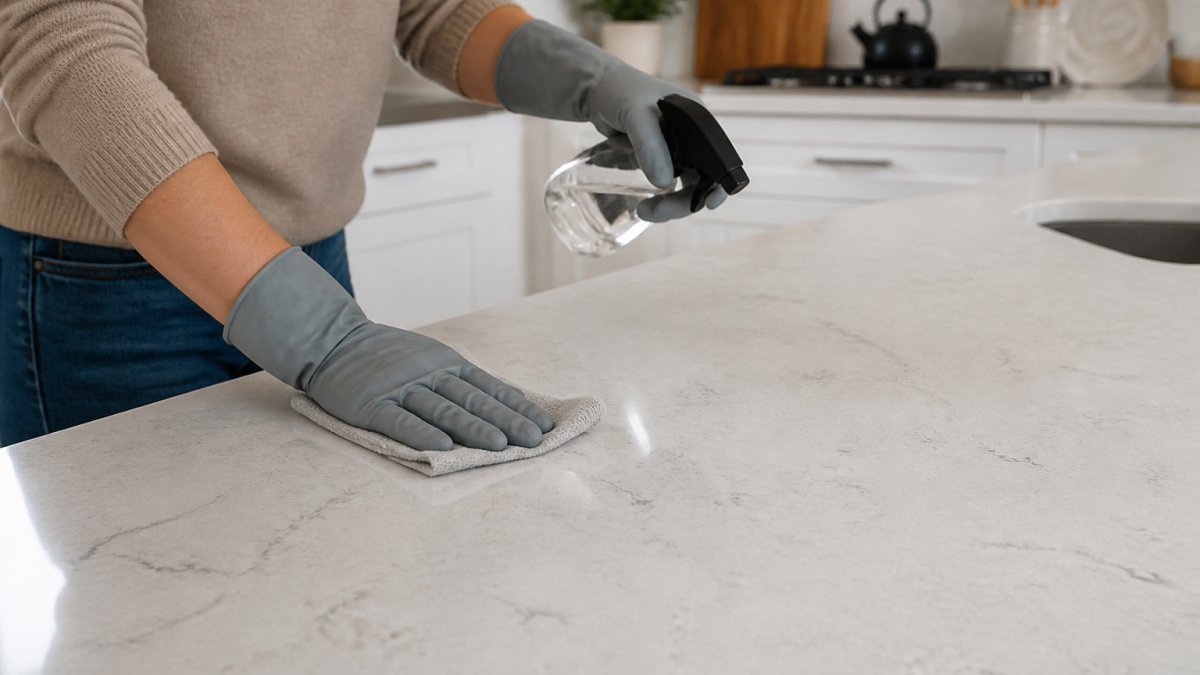
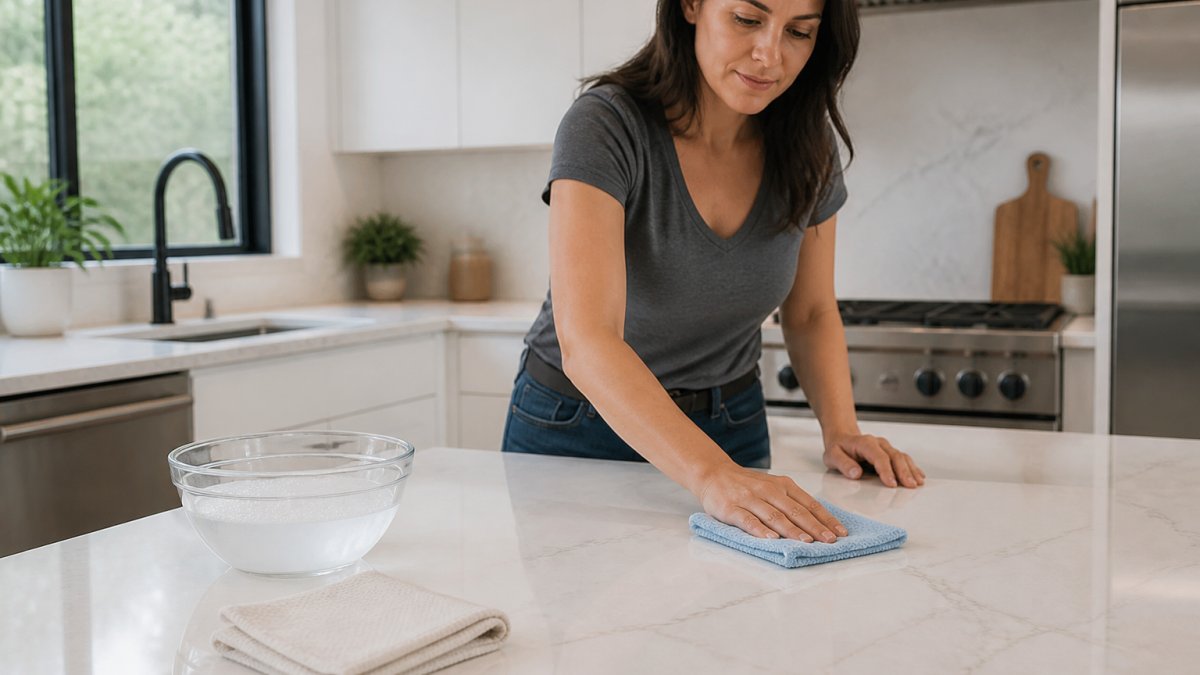
Daily cleaning takes under a minute. Wipe the surface with warm water, a drop of mild dish soap, and a soft cloth, then dry it with a second cloth to prevent water spots.
For routine cleaning, follow these steps:
- Mix a few drops of mild dish soap into a bowl of warm water
- Dip a microfiber towel or non-abrasive sponge into the solution
- Wipe the entire countertop using gentle, circular motions
- Rinse the cloth and wipe away soap residue with clean water
- Dry the surface with a separate soft cloth
Tools and Cloths That Won't Scratch
Microfiber towels, soft cotton cloths, and non-abrasive sponges are the only tools you need. Skip scouring pads, steel wool, and stiff brushes entirely. Even though quartz ranks high on the Mohs hardness scale, the resin binder between the quartz crystals is softer, and abrasive tools dull the finish over time. Keep one cloth for washing and one for drying so you never smear residue back across the surface.
Wiping Spills and Food Residue Promptly
Wipe spills as they happen, especially wine, coffee, tomato sauce, and oil. Quartz is nonporous, so liquids sit on top rather than soaking in, but leaving a spill overnight gives it time to bond with the surface. Dried spills and food residue come off easily with a warm, damp cloth left in place for a minute to soften the mess.
Best Cleaner for Quartz Countertops: What Works and What to Avoid
The best everyday cleaner for quartz is warm water with a small amount of mild dishwashing liquid. For disinfection after handling raw meat or poultry, a diluted isopropyl alcohol solution (roughly 1 part 70% alcohol to 1 part water) works without harming the finish, wipe, let it sit briefly, then rinse and dry.
Cleaning vs. Disinfection: Know the Difference
Cleaning removes soil, grease, and food debris. Disinfection reduces germs on a surface that has already been cleaned. Quartz is nonporous, so it does not harbor bacteria the way a porous stone can, but food-prep surfaces still need periodic disinfection. A common pattern is to clean first with soap and water, then disinfect with diluted isopropyl alcohol, then rinse and dry.
How to Read a Cleaner Label Before You Spray
Most damage to quartz comes from a product that was never meant for it. Before using any new cleaner, check the label for these signals:
- Acids: citric acid, acetic acid (vinegar), hydrochloric acid, phosphoric acid. Repeated use etches the finish.
- Abrasives: calcium carbonate, silica, pumice, "scouring" or "powder" formulas. These scratch the surface.
- Bleach and strong oxidizers: sodium hypochlorite, hydrogen peroxide in high concentrations. These break down the resin binder.
If a product is labeled for natural stone but not quartz, treat it as unsafe until the manufacturer confirms otherwise. Stone-specific cleaners are formulated for granite, marble, and quartzite, not for a resin-bound engineered surface.
The Do-Not-Use List
| Product Type | Safe for Quartz? | Why |
|---|---|---|
| Mild dish soap + warm water | Yes | Everyday cleaning, no residue |
| Diluted isopropyl alcohol (70%) | Yes | Disinfection after raw meat |
| Bleach | No | Breaks down the resin binder |
| Vinegar, lemon juice, or other acids | No | Etch the finish over time |
| Scouring pads, steel wool, abrasive powders | No | Scratch the surface permanently |
| Acetone or nail polish remover | No | Can dull or dissolve the finish |
| Ammonia-based glass cleaner | No | Clouds polished surfaces with repeated use |
| Oven cleaner or drain cleaner | No | Caustic; damages resin and finish |
Manufacturer Guidance Beats Generic Advice
Resin content, finish type, and cure method vary by manufacturer, and care instructions can differ from one slab to the next. Your slab documentation, the care sheet that came with the counter or the fabricator's paperwork, is the final authority. When in doubt, follow it over any general guide, including this one. If you cannot find the documentation, the fabricator who installed the counter can usually supply the correct care sheet.
Food-Safety Sanitizing Without Damaging the Finish
For a food-prep surface, the safe sequence is: clean with soap and water, disinfect with diluted isopropyl alcohol, then rinse with clean water and dry. Avoid bleach-based sanitizers and quaternary ammonium products unless the manufacturer explicitly approves them. A spray bottle of 1:1 water and 70% isopropyl alcohol kept under the sink covers most kitchen disinfection needs without risking the finish.
How to Remove Stains from Quartz Countertops
Most marks on quartz lift with a warm, damp cloth and a drop of mild dish soap. What separates a counter that stays clean from one that develops a permanent shadow is matching the method to the stain. Quartz is nonporous, so the goal is to lift the substance off the surface before it bonds with the resin binder, not to scrub harder.
Stain-by-Stain Removal Methods
| Stain | Method | Dwell Time | Caution |
|---|---|---|---|
| Oil or grease | Baking soda paste (3 parts baking soda, 1 part water) | 10-15 minutes | Do not use oil-based cleaners on honed finishes |
| Coffee or tea | Baking soda paste, then diluted isopropyl alcohol wipe | 5-10 minutes | Rinse fully; alcohol left to dry can dull polished surfaces |
| Red wine | Blot first, then baking soda paste | 5-10 minutes | Never rub, blotting prevents spreading |
| Ink or permanent marker | Isopropyl alcohol (70%) on a cloth, dabbed directly | 30-60 seconds | Test on a hidden area first; rinse and dry immediately |
| Dried food | Warm damp cloth laid flat to soften, then wipe | 1-2 minutes | Do not scrape with a blade or abrasive pad |
| Hard water film | Diluted isopropyl alcohol or a 1:1 water-and-alcohol wipe | Immediate | Dry after wiping to prevent new spots |
| Nail polish | Non-acetone polish remover on a cloth, dabbed | 30 seconds | Acetone can etch the finish, avoid it |
Step-by-Step for the Two Hardest Cases
Oil and grease. Oil spreads before it sets, so blot the excess with a paper towel first. Mix a paste of three parts baking soda to one part water, spread it over the mark about an eighth of an inch thick, and let it sit 10 to 15 minutes.
Ink and permanent marker. Dampen a corner of a microfiber cloth with 70% isopropyl alcohol and dab, do not rub, the mark. Most ink lifts in under a minute.
When a Stain Won't Lift
If a mark survives two rounds of the appropriate method, stop. Repeated scrubbing is more likely to dull the finish than to remove the stain. Persistent discoloration usually means the substance has bonded with the resin, and the fix is a professional polish or a color-matched resin repair, not a stronger household chemical. Photograph the stain and note what caused it before calling a fabricator; that information shortens the repair.
Click and Make your "IN-STORE" appt today! →
Preventing Stains Before They Set
The single most effective habit is speed. Wine, coffee, tomato sauce, and oil should be wiped within minutes, not hours. Keep a microfiber cloth and a spray bottle of diluted dish soap within reach of the prep area so wiping is easier than walking away. During cooking, a quick wipe between tasks prevents buildup without any extra effort.
Quartz Countertop Heat Resistance and Damage Prevention
Quartz countertop heat resistance has a hard limit: the resin binder can scorch or crack around 300°F, so never set a hot pan directly on the surface. Always use trivets or a cutting board under hot cookware.
Trivets, Cutting Boards, and Impact Protection
Keep trivets within arm's reach of the stove so hot cookware never touches the counter. Use a cutting board for all chopping, since knives and heavy impacts can chip the edges. Avoid standing on countertops and be careful with cast iron and heavy appliances near the edges, where impact damage is most likely. If a chip does occur, a professional can often repair it with color-matched resin, but prevention is far cheaper than repair.
Finish-Specific Care: Polished vs Honed Quartz
Polished quartz shows smudges and water spots more readily, while honed quartz hides them but holds onto oils and fingerprints. Match your cleaning routine to the finish. On polished surfaces, dry immediately after wiping to keep the shine streak-free. On honed surfaces, use a slightly damp cloth and avoid oil-based cleaners that can darken the matte finish. Both finishes benefit from the same mild soap and water routine, so you do not need separate products for each.
A Simple Quartz Countertop Maintenance Schedule
A consistent routine keeps quartz in showroom condition without much effort. Here is the schedule we recommend to every client:
| Frequency | Task | Time Needed |
|---|---|---|
| Daily | Wipe with warm water and mild dish soap | Under 1 minute |
| Weekly | Disinfect with diluted isopropyl alcohol | 2-3 minutes |
| Monthly | Check edges and seams for chips or lifting | 5 minutes |
| As needed | Treat stains with baking soda paste | 5-10 minutes |
Sealing is not required for quartz, unlike granite, marble, or quartzite. If you are comparing materials for a remodel, our team at My Kitchen Design EXPO can walk you through the durability differences between quartz and natural stone before you commit.
Maintaining quartz comes down to three habits: clean with mild soap and water, protect the surface from heat and impact, and act on stains the same day. When you are ready for new countertops, My Kitchen Design EXPO handles the entire project as a one-stop shop, from custom cabinetry to granite and quartz installation.
Frequently Asked Questions
What maintenance do quartz countertops need?
Quartz countertop maintenance is mostly simple daily care. Wipe the surface with warm water, mild dish soap, and a soft cloth or microfiber towel, then dry it to prevent water spots. Quartz is a nonporous, resin-bound surface, so it does not need sealing the way granite or marble does. Avoid abrasive cleaners, scouring pads, bleach, and harsh chemicals. Use trivets under hot cookware and cutting boards under knives to prevent heat damage and scratches.
Should you use Clorox wipes on quartz?
Disinfecting wipes that contain bleach or harsh chemicals can dull a quartz surface finish over time, especially on polished quartz. For everyday disinfection after food preparation, a diluted mild dish soap solution or a cleaner labeled safe for quartz works better. If you want to disinfect, check the product label for quartz compatibility first. Rinse with warm water and dry with a soft cloth afterward to keep the surface looking new.
Can I use Dawn dish soap on quartz?
Yes. Mild dish soap, including Dawn dishwashing liquid, is one of the best cleaners for quartz countertops. Mix a few drops in warm water, wipe with a soft cloth or non-abrasive sponge, then rinse and dry. This handles daily cleaning, food residue, and light spills without harming the resin-bound surface. Skip anything labeled abrasive or containing bleach, and avoid scouring pads that can scratch the finish.
Can I put a hot cup of coffee on quartz?
A hot mug can leave a mark or cause thermal shock on quartz, so use a coaster or trivet. Quartz countertop heat resistance is lower than granite or quartzite because the resin binder in quartz can be damaged by sudden high heat. Never place hot cookware straight from the stove or oven on the surface. For extra protection, keep trivets within reach and set hot pans on the stovetop or a cooling rack instead.
How do you remove stains from quartz countertops?
For most stains, wipe with warm water and mild dish soap first. For dried residue or stubborn marks, let a paste of baking soda and water sit on the spot for a few minutes, then gently wipe with a non-abrasive sponge. For hard water spots, a quartz-safe cleaner designed for mineral deposits works well. Avoid bleach, scouring pads, and harsh chemicals, which can dull the finish or damage the resin-bound surface.
Do quartz countertops need to be sealed?
No. Quartz is a nonporous surface, so unlike natural stone such as granite or marble, it does not require sealing. The resin binder keeps liquids from soaking in, which is why quartz countertop maintenance is simpler than stone care. Focus instead on daily cleaning with warm water and mild dish soap, prompt spill cleanup, and protecting the surface from heat and scratches to keep it looking new.
What cleaners should you avoid on quartz countertops?
Avoid abrasive cleaners, scouring pads, bleach, and harsh chemicals. Products containing ammonia, high-acid ingredients, or heavy solvents can dull the surface finish or damage the resin-bound surface over time. Skip oven cleaners, paint removers, and anything labeled abrasive. For routine cleaning, stick with warm water, mild dish soap, and a soft cloth or microfiber towel, and always check that a cleaner is labeled safe for quartz.
How do you prevent scratches and heat damage on quartz?
Use a cutting board for all chopping and prep work to prevent scratches and chip prevention. Set hot cookware on trivets or a cooling rack, never directly on the countertop. Lift items instead of dragging them, and keep heavy pots away from the edges to reduce impact damage. A simple routine of prompt spill cleanup, gentle wiping, and heat protection keeps quartz countertops durable and looking new for years.