 Comparison
Plywood vs Particle Board for Kitchen Cabinets Compared
Quick Summary
Plywood vs particle board for kitchen cabinets comes down to construction and moisture: plywood is made of layered wood veneers and holds screws and resists water better, while particle board is made of resin-bonded chips and sawdust and costs less. Plywood suits sink bases and load-bearing boxes, while particle board works in dry, interior locations.
- Plywood is made from thin wood veneers glued in alternating grain directions.
- Particle board is made from wood chips and sawdust bonded with resin.
- Plywood generally holds screws well because its layered grain resists splitting.
- Particle board swells at surface and edges when water exposed, and the swelling does not reverse.
- Compare quotes on equal terms by requesting the same kitchen with plywood and particle board boxes.
Table of Contents
- Plywood vs Particle Board for Kitchen Cabinets Compared
- Plywood vs Particle Board: The Core Differences
- Plywood vs Particle Board Price: A Like-for-Like Cost Comparison
- Strength, Screw Holding, and Hardware Performance
- Moisture, Water Exposure, and Failure Modes in Kitchens
- How Long Will Particle Board Cabinets Last?
- Particle Board Cabinets Painting: What to Expect
- Plywood vs Particle Board vs MDF: Which Fits Each Cabinet Part
- Choosing Your Cabinet Material Before Your Kitchen Design Is Finalized
- Frequently Asked Questions
Plywood vs Particle Board for Kitchen Cabinets Compared
Last Updated: November 15, 2026
Plywood vs Particle Board: The Core Differences
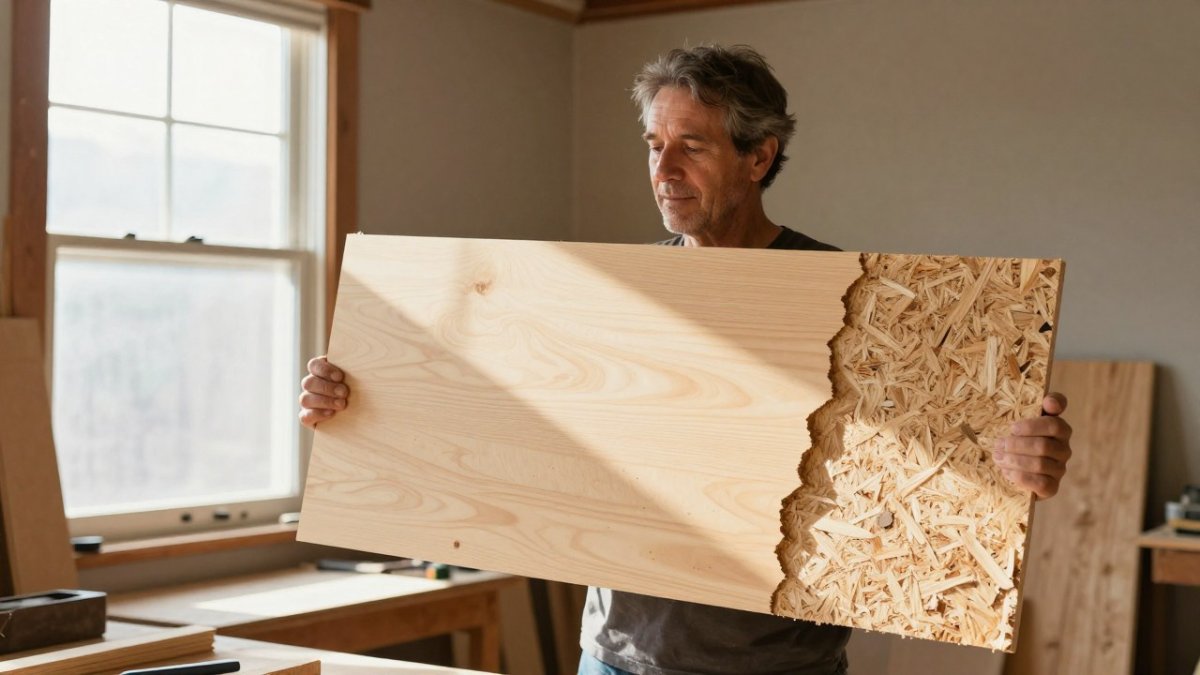
Plywood is made from thin wood veneers glued together in alternating grain directions, while particle board is made from wood chips and sawdust bonded with resin. That single difference in construction drives almost every performance gap between the two materials. For kitchen cabinets, it affects how well a cabinet box holds screws, handles moisture, and keeps its shape over time.
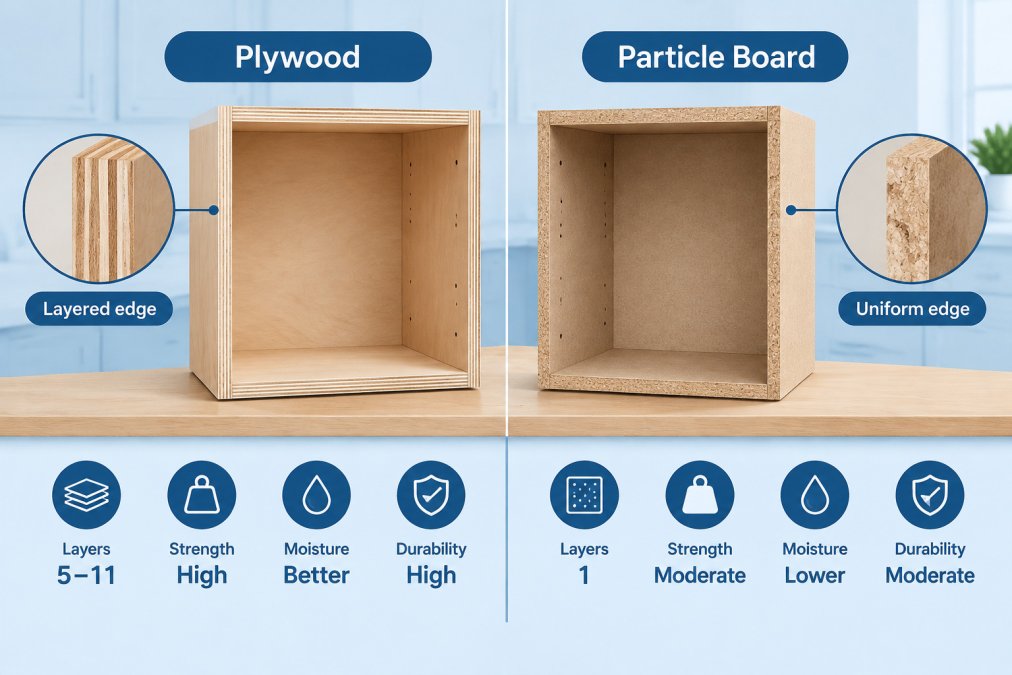
Plywood is generally regarded as the stronger and more moisture-resistant of the two. Our experience at My Kitchen Design EXPO is that the right choice depends less on the label and more on where the material sits in the cabinet and how the box is built.
Here is the short version:
- Plywood: Layered wood veneers, stronger screw hold, better water tolerance, higher cost.
- Particle board: Compressed wood particles, lower cost, smoother surface for coatings, weaker at fastener points and edges exposed to water.
Plywood vs Particle Board Price: A Like-for-Like Cost Comparison
Most comparisons stop at "particle board is cheaper." That is true at the sheet level, but it is a poor way to budget a kitchen because the core material is only one line item in a cabinet's total cost. A like-for-like comparison has to hold the cabinet size, door style, finish, hardware, and construction method constant, then change only the box material.
The cost of a cabinet is shaped by more than the raw panel. Labor, hardware, finishing, and assembly all contribute to the final price.
Here is how the cost generally breaks down for a cabinet:
- Core panel material: The plywood-versus-particle-board delta on the box panels. This is the only line that changes when you switch cores.
- Doors and drawer fronts: Usually the largest single cost. A painted MDF or particle board door and a plywood door with a veneered face can differ substantially, and this choice is independent of the box core.
- Hardware: Hinges, slides, and pulls are priced per unit and are the same regardless of core material. Soft-close and full-extension upgrades add cost on either core.
- Edge banding and edge treatment: Sealing cut edges costs money on both materials, but particle board edges need more careful sealing to perform, so a properly built particle board box can narrow the price gap.
- Finishing and assembly labor: Largely the same for either core. A shop that builds both materials will usually quote similar labor hours.
- Finish and installation: Independent of core material.
Two quotes for the same kitchen can differ for many reasons, so a like-for-like comparison is the most useful way to evaluate them.
Several factors push the number up or down:
- Cabinet size and count: More boxes mean more panel area, so the core-material delta scales with the number of cabinets, not with the room's square footage.
- Box thickness: A 5/8-inch box and a 3/4-inch box use different panel quantities and change both material and hardware fit.
- Plywood grade: Cabinet-grade plywood with a sanded face and void-free core costs more than sheathing-grade plywood. Ask which grade is quoted.
- Edge treatment: Fully edge-banded and sealed boxes cost more to build but perform better in both materials.
- Region and supplier: Panel prices vary by market and by whether the shop buys full units or cut-to-size components.
- Finish: Painted, laminated, and veneered faces carry different costs that are separate from the core.
Watch out: A quote that lists only a total price hides which core, thickness, and edge treatment you are getting. Ask for an itemized quote that separates the box core, box thickness, edge banding, doors, drawer fronts, and hardware so you can compare two bids on equal terms.
A practical way to compare is to request the same kitchen quoted twice, once with plywood boxes and once with particle board boxes, with every other specification held identical. The difference between those two numbers is the true cost of the upgrade, and it is usually easier to justify than the sheet-price gap suggests. If a supplier cannot or will not quote both, that itself tells you something about how the cabinets are built.
Strength, Screw Holding, and Hardware Performance
Strength matters most at the points where hardware goes in. Hinges, drawer slides, and shelf pins all rely on screws that grip the core material. Plywood generally holds screws well because its layered grain resists splitting and stripping.
Watch out: Overtightening screws in particle board is a common cause of stripped holes. Use the correct pilot size and avoid cranking drawer screws past snug.
Drawer slides and heavy doors show the difference most clearly. A plywood box usually keeps hardware tight for years, while particle board joints may loosen first at the front corners. Hardware choice also matters: soft-close hinges and full-extension slides place more stress on the box than basic components, which makes plywood a safer pick for those upgrades.
The article's key performance points, side by side:
| Factor | Plywood | Particle board |
|---|---|---|
| Construction | Thin wood veneers in alternating grain | Wood chips and sawdust bonded with resin |
| Screw holding | Holds screws well; resists splitting | Prone to stripping if overtightened |
| Water tolerance | Better water tolerance | Swells at surface and edges when wet |
| Cost | Higher cost | Lower cost |
Moisture, Water Exposure, and Failure Modes in Kitchens
"Moisture resistance" is too broad to be useful, because a kitchen exposes cabinets to several very different water scenarios, and the two materials respond differently to each. Separating those scenarios is the most practical way to decide which core belongs where.
Everyday humidity and cooking steam. Normal kitchen air carries moisture from boiling, dishwashing, and general humidity.
Spills and splashes. A splash on a sealed, finished surface is usually a non-event for either material, because the finish sheds the water before the core sees it.
Slow leaks. A dripping supply line, a failed valve, or a slow drain leak under the sink is the classic failure scenario. Water pools on the cabinet bottom and wicks into edges.
Overflow and flooding. A dishwasher overflow, a supply-line burst, or a flooded floor sends a large volume of water into the cabinet in a short time.
Prolonged soaking. This is the worst case for both materials. Particle board that stays wet can disintegrate at the edges and grow mold in the core. Plywood can delaminate and lose glue-line integrity.
The mechanism matters because it explains why damage is often permanent.
What happens after drying is the part most buyers do not hear about. A particle board panel that has swollen will usually stay swollen, and a swollen edge can push against a door, bind a drawer, or lift a countertop.
A few habits reduce risk regardless of core:
- Check the base of the sink cabinet every few months for soft spots, staining, or a musty smell.
- Look under the dishwasher and around the supply lines for drips.
- Keep the exhaust hood running during cooking to limit routine steam exposure.
- Confirm that cut edges on boxes, shelves, and drawer parts are sealed or banded.
Watch out: A sealed edge is not a waterproof edge. Even a well-banded particle board panel can swell if water stands against it long enough, so treat edge sealing as risk reduction, not as a guarantee.
The practical takeaway is to match the material to the exposure. Plywood is generally considered the more water-tolerant choice for sink bases, dishwasher-adjacent boxes, and any cabinet that could see a leak.
How Long Will Particle Board Cabinets Last?
Particle board cabinets can last many years in dry, well-maintained kitchens, but lifespan depends heavily on moisture exposure and how the box was built. A particle board cabinet in a low-moisture area with no leaks can serve a household for a long time. One in a sink base exposed to repeated leaks may need replacement much sooner.
Plywood generally outlasts particle board in demanding conditions. Durable finishes, sealed edges, and prompt leak repair extend the life of either material.
Particle Board Cabinets Painting: What to Expect
Particle board can take paint well when it is primed properly. Use a bonding primer designed for engineered wood, and sand lightly between coats to avoid raised grain or visible seams.
Paint does not seal the edges. Unsealed particle board edges still absorb moisture, so apply primer and paint to every edge and exposed surface. Plywood also paints well, and it holds paint over the grain lines with less risk of edge swelling when moisture is present.
Plywood vs Particle Board vs MDF: Which Fits Each Cabinet Part
Each material has a natural place in a cabinet. A common approach is to match the material to the demand placed on each part:
- Cabinet boxes (sides, bottoms, and shelves): Plywood is the better choice for load-bearing parts and areas near the sink or dishwasher.
- Doors and drawer fronts: MDF or particle board with a sealed finish works well for painted or laminated surfaces away from water.
- Interior drawer boxes: Plywood holds slides and load better over time.
- Back panels: Thin plywood or hardboard is usually sufficient.
MDF is dense and smooth, which suits painted doors, but it swells badly when wet and does not hold screws as well as plywood. Particle board sits between the two on cost and performance, and it belongs in dry areas or as a budget choice for non-structural parts.
Choosing Your Cabinet Material Before Your Kitchen Design Is Finalized
Settle on cabinet materials before the design is locked, because material affects thickness, hardware, and finish options. Ask your designer which parts of the cabinet will use plywood and which will use particle board or MDF, and request that the drawings reflect the decision. Confirm how the sink base will be built and whether the bottom panel is plywood.
My Kitchen Design EXPO offers 3D virtual modeling to show the finished kitchen before construction begins. The business provides a one-stop design and turn-key construction service. If you want guidance on which material fits your kitchen, contact our team to review options.
Frequently Asked Questions
Is plywood or particle board better for cabinets?
For kitchen cabinets, plywood is generally the stronger choice. It holds screws better, resists swelling from humidity and small leaks more effectively, and typically lasts longer under daily loads like heavy doors and drawers. Particle board costs less and works well for budget projects or areas with little moisture exposure. Compare each option against your budget, how often the kitchen is used, and how much water exposure the cabinets will see.
How do plywood and particle board cabinets compare in price?
Particle board cabinet material usually costs less than plywood. Pricing varies with grade, thickness, finish, and project size, so a like-for-like quote is the only reliable comparison. My Kitchen Design EXPO does not publish fixed prices for these materials, so contact the team or visit mkdexpo.com for a current quote based on your layout and selections.
How long will particle board cabinets last?
Particle board cabinets can last many years in dry, low-stress conditions, but they are more vulnerable than plywood to swelling after water leaks and to loosening at screw joints over time. Plywood construction is often associated with longer service life. Keeping sinks and dishwashers sealed and fixing leaks quickly makes a significant difference in how long particle board holds up.
Can particle board kitchen cabinets be painted?
Yes, particle board cabinets can be painted, and the surface is often smooth enough for a consistent finish. Proper preparation matters most: clean the surface, sand lightly, apply a bonding primer suited to engineered wood, and use a durable topcoat. Edges and any exposed core areas absorb paint unevenly, so sealing them with primer is important. Painted particle board is best kept away from standing water.