 Comparison
Are Slab Backsplashes Worth It in 2026? A Cost and Trade-Off Review
Last Updated: November 6, 2026
Quick Summary
A slab backsplash is worth it when a seamless look and easier cleaning matter more than upfront cost, since it has far fewer grout lines than tile. It costs substantially more than tile and demands precise measurements and a flat, sound wall. If your budget is tight or you want varied patterns, tile is usually the better value.
- A slab backsplash is cut from one piece of stone or engineered material, leaving far fewer grout lines than tile.
- Slab generally wins on appearance and ease of cleaning, while tile generally wins on price and flexibility.
- Quartz slab backsplashes cost substantially more than tile, so get quotes that itemize each cost line.
- Measure after the cabinets are set, since errors in a fabricated slab are difficult to correct.
- Keep remnant pieces and photograph the slab, because matching a replacement later is not guaranteed.
Table of Contents
- What a Slab Backsplash Is and How It Differs From Tile
- Slab Backsplash Cost: What You Can Expect to Pay in the US
- Slab Backsplash vs Tile Cost by Material and Project Size
- Quartz Slab Backsplash Pros and Cons
- Full Height Backsplash Quartz: Design, Installation, and Constraints
- Cleaning, Durability, and Long-Term Ownership
- Will a Slab Backsplash Still Look Good in 2026 and Beyond?
- Deciding Whether a Slab Backsplash Is Worth It for Your Kitchen
- Frequently Asked Questions
What a Slab Backsplash Is and How It Differs From Tile
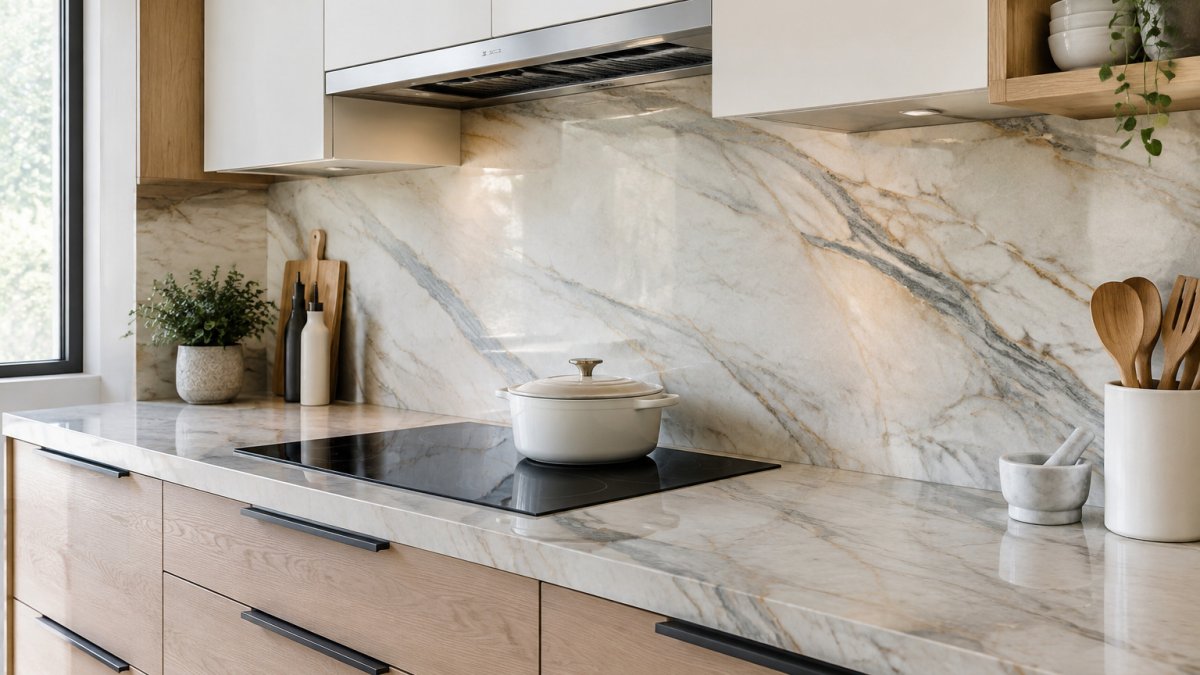
A slab backsplash is a full-height wall covering cut from a single piece of stone or engineered material such as quartz.
Full-height slab designs have become a prominent kitchen trend for 2026.
The biggest visible difference is the seam. A slab backsplash has far fewer grout lines, which is why many homeowners choose it for a clean, uninterrupted look.
Installation also differs. A slab must be fabricated to exact measurements and fitted precisely, so mistakes are harder to hide.
Slab Backsplash Cost: What You Can Expect to Pay in the US
Slab backsplash pricing varies widely with material, slab size, edge detail, wall condition and fabrication. A reliable quote comes from measuring your specific wall, not a national average.
Pricing depends on several factors:
- Material: Natural stone and premium quartz typically cost more than standard quartz colors.
- Square footage: A full-height run across a large kitchen adds up quickly.
- Fabrication details: Outlet cutouts, edge profiles and corners increase labor.
Pricing depends on material, dimensions, and scope. For current pricing on slab backsplashes at My Kitchen Design EXPO, visit our website or request a quote so we can measure your kitchen and provide a number based on your actual project.
Slab Backsplash vs Tile Cost by Material and Project Size
A single per-square-foot range is often not enough to budget a kitchen, because the slab itself is only part of the total. An itemized installed cost by material and project size is more useful for planning.
What goes into an installed slab backsplash price
A slab backsplash quote is built from five line items. Ask for each one separately so you can compare bids fairly.
- Slab material: Priced per square foot, and slabs are sold as whole pieces, so you often buy more than the wall requires. Natural stone and premium quartz sit at the top of the range; standard quartz sits lower.
- Fabrication: Cutting, polishing edges, mitering corners, and matching the backsplash to the countertop run, usually priced per linear or square foot.
- Cutouts: Each outlet, switch, range hood, or window edge is a separate fabrication step.
Tile is priced on the same five lines, but labor is spread across many small pieces and cutouts are cut on site rather than fabricated in a shop, which is why tile's installed cost is lower even when the tile itself is not cheap.
Itemized comparison by material
| Cost line | Tile backsplash | Quartz slab backsplash | Natural stone slab backsplash |
|---|---|---|---|
| Material | Low to moderate per sq. ft. | Moderate to high per sq. ft. | High per sq. ft.; varies by stone |
| Fabrication | Minimal; cut on site | Shop fabrication and edge polishing | Shop fabrication, edge polishing, and sealing |
| Cutouts | Cut on site, low added cost | Fabricated per opening | Fabricated per opening |
| Installation | Moderate labor, many pieces | High labor, heavy pieces, two-person set | High labor, heaviest pieces, careful handling |
| Removal and wall prep | Similar | Similar, plus flat-wall requirement | Similar, plus flat-wall requirement |
| Grout and sealing | Grout and periodic resealing | Minimal grout; no routine sealing for quartz | Minimal grout; periodic sealing for many stones |
Cost by project size
Ask your fabricator how much of the slab will be usable and whether remnants from the countertop can be applied to the backsplash.
Where slab earns back its premium
Slab eliminates grout lines, removing the periodic scrubbing and resealing tile grout requires, which is a maintenance saving rather than a cash rebate.
For a project-specific number, request a quote so the slab, fabrication, cutouts, installation, and removal can be priced against your actual wall measurements.
Quartz Slab Backsplash Pros and Cons
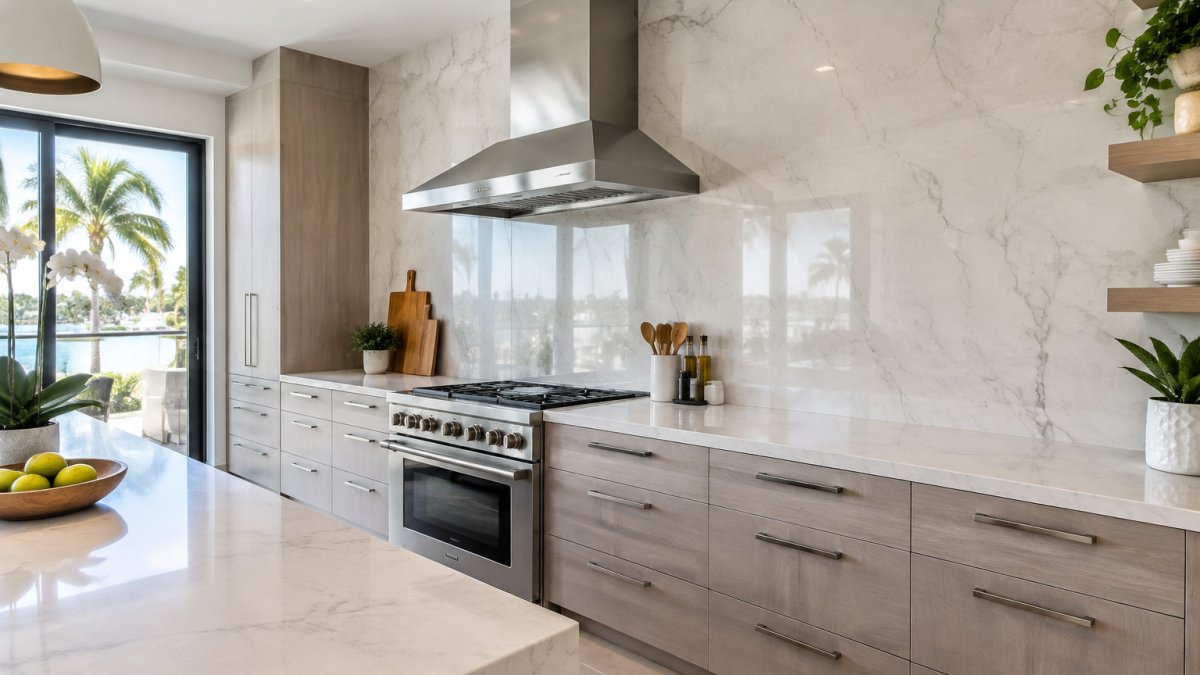
Quartz is one of the most common materials for slab backsplashes. It is engineered from natural quartz particles bonded with resin, which makes it less porous than many natural stones.
Pros:
- Seamless appearance: Matching the backsplash to the countertop creates a single surface.
- Easier cleaning: Fewer grout lines mean fewer places for grime to collect.
- Consistent color: Quartz offers uniform patterns, which suits homeowners who want predictable results.
Cons:
- Higher cost: Quartz slab backsplashes cost substantially more than tile.
- Precise installation: Errors in measurement are difficult to correct once the slab is fabricated.
- Heat sensitivity: Quartz resins can be damaged by very high heat, so keep hot pans away from the surface.
Watch out: ordering a slab before confirming wall measurements and outlet locations can lead to costly remakes. Have the space measured after the cabinets are set.
Full Height Backsplash Quartz: Design, Installation, and Constraints
A full-height quartz backsplash extends from the countertop to the upper cabinets or the ceiling. This design makes the kitchen feel taller and more cohesive, but it places more demands on installation.
Full-height runs require careful planning for outlets, switches, range hoods and window edges. Each cutout must be fabricated to match, and the slab must be supported correctly so it does not stress the wall.
Constraints to consider include:
- Wall flatness: Uneven drywall can show gaps at the seams.
- Slab size: Very long runs may require multiple pieces, which reintroduces seams.
- Lighting and access: Under-cabinet lighting may need to be relocated before installation.
Cleaning, Durability, and Long-Term Ownership
The more useful question is what low-maintenance means for your specific material, and what happens when something goes wrong years after installation. Quartz, granite, marble, and other slab materials behave differently under heat, stains, and impact, and the repair path differs for each.
Material-specific performance and care
| Material | Sealing needed | Heat tolerance | Staining risk | Routine care |
|---|---|---|---|---|
| Quartz (engineered) | No routine sealing | Low to moderate; resins can be damaged by high heat | Low; surface is typically non-porous | Damp cloth and mild soap; avoid abrasive pads |
| Granite | Periodic sealing, depending on finish | High | Low to moderate; sealant refresh helps | Mild soap; reseal on the schedule your fabricator recommends |
| Marble and other calcium-based stone | Periodic sealing | Moderate | Higher; acids such as vinegar, citrus, and wine can etch the surface | pH-neutral cleaner only; blot spills rather than wipe |
| Soapstone and similar dense stone | Often left unsealed by choice | High | Low, but can darken with oil over time | Mineral oil if a darker patina is desired |
Two practical rules follow. First, never assume a slab is care-free; even quartz benefits from prompt cleanup of oily or pigmented spills. Second, match the cleaner to the stone: an acidic cleaner fine on quartz can etch marble permanently, and an abrasive pad fine on granite can dull polished quartz.
Watch out: placing a hot pan or a slow cooker against a quartz backsplash can scorch the resin. Use a trivet and keep heat-generating appliances a few inches off the surface.
What actually damages a slab backsplash
The most common long-term problems are not stains. They are impact damage and movement.
- Chips: Usually at edges, corners, or around cutouts, caused by a dropped object or a pot struck against the wall. Small chips can often be filled and polished by a fabricator so the repair is hard to see.
- Cracks: Often trace back to an uneven wall, inadequate support, or a slab that was forced into place. A hairline crack may be stabilized with epoxy; a structural crack may require replacing the piece.
- Stains: More likely on porous natural stone than on quartz. Prompt blotting prevents most of them, and a poultice can draw out some set-in stains on natural stone.
Repair and replacement realities
The hard truth about slab backsplashes is that a matching replacement is not guaranteed. Stone and engineered slabs are produced in batches, and dye lots and veining change over time. A quartz color current today may be discontinued in five years, and a natural stone from a specific quarry may no longer be available in the same vein pattern.
That changes how you should plan:
- Keep the offcuts. Ask your fabricator whether they can leave you the remnant pieces from your slab, which can be a useful source for a future repair patch.
- Photograph the slab before installation. A record of the veining helps a fabricator match a repair or source a close replacement.
- Ask about the warranty. Ask what coverage applies to your chosen material and whether impact damage is included.
- Plan for a partial replacement. If a matching piece cannot be found, the practical fix is often to replace one section and accept a visible seam, or to reface the whole run.
Long-term ownership checklist
Before the slab goes up, confirm four things: the wall is flat and structurally sound, the slab is supported correctly, the cutouts are measured after cabinets are set, and you have the remnant pieces and warranty paperwork. Those steps prevent most damage scenarios above and make future repairs easier.
A slab backsplash is genuinely easier to live with than tile in daily use, but it is not indestructible. Treat it as a finished surface that can be repaired but not always perfectly matched, and the long-term ownership experience is predictable rather than a surprise.
Will a Slab Backsplash Still Look Good in 2026 and Beyond?
Full-height slab designs are popular right now, but trends change. Neutral tones and subtle veining are often seen as staying in style longer than bold, highly patterned stone.
Resale appeal can matter too. However, no finish guarantees resale value, and the overall condition and style of the kitchen matter far more.
If you prefer a timeless look, choose a restrained color and pattern.
Deciding Whether a Slab Backsplash Is Worth It for Your Kitchen
A slab backsplash is worth it when the seamless look, easier cleaning and long-term appearance matter more than the higher upfront cost.
Consider these questions:
- Do you value a clean, uninterrupted surface above lower cost?
- Is your kitchen a focal point you plan to keep for many years?
- Are your walls flat and your layout settled, so measurements will hold?
- Can you accept a higher price per square foot for the look you want?
If you answered yes to most of these, a slab backsplash is likely a good investment.
My Kitchen Design EXPO has served Central Florida homeowners since 2009, offering a one-stop process that includes design, cabinetry, countertops and turn-key construction.
Frequently Asked Questions
Are slab backsplashes worth it?
A slab backsplash is worth considering if you want a seamless, low-grout surface that visually connects with your countertop and you can accept a higher installed cost than tile. The value depends on your budget, how long you plan to stay, and whether your kitchen layout suits a large slab. For many homeowners the trade-off comes down to appearance and easier cleaning versus a substantially higher price. Get a written quote from your designer that itemizes material, fabrication, and installation before deciding.
Is a slab backsplash easier to clean than tile?
Generally yes. A slab backsplash has fewer grout lines than tile, which means fewer places for dirt, grease, and moisture to collect. Wiping a smooth surface is usually faster than scrubbing grout. Cleaning routines still depend on the material, so ask about sealing and recommended cleaners for natural stone versus engineered quartz before installation.
How much does a slab backsplash cost compared with tile?
Actual pricing varies with material, project size, and site conditions. My Kitchen Design EXPO does not publish standard prices; pricing depends on material, dimensions, and scope, so request a quote for your specific kitchen.
Will a slab backsplash look dated in 10 years?
A full-height slab backsplash in a neutral or classic stone pattern tends to age more gracefully than a bold trend. Full-height slab designs are a popular kitchen style, and trends can shift. Choosing a restrained veining pattern and coordinating it with your cabinetry reduces the risk of a dated look. Consider your own taste first, since a finish you love will hold its value for you regardless of trends.