 How-to
How to Mix Metal Finishes in Kitchen: 7 Steps
Quick Summary
To mix metal finishes in a kitchen, choose one dominant finish for the largest surfaces, add one or two accent finishes in small doses, and repeat each finish in at least two places. Pairing a warm metal with a cool one usually creates the most balanced look.
- Choose the dominant finish first, matching your largest existing element such as a stainless range or big sink.
- Pair one warm metal like brass or gold with one cool metal like chrome or matte black.
- Map each finish to a placement zone and keep each accent finish to three or four items.
- Repeat each finish in at least two places so the mix reads as a deliberate choice.
- Check finishes under the actual lighting you plan to use, since warm and cool light change how metal looks.
Table of Contents
- Why Mixing Metal Finishes Works in a Kitchen
- Step 1: Choose a Dominant Metal Finish
- Step 2: Pair Warm and Cool Metal Tones
- Step 3: Map Each Finish to a Placement Zone
- Step 4: Coordinate Faucets, Cabinet Hardware, and Lighting
- Mixing Metals Chart: Pairings That Work and Pairings to Avoid
- Working With Existing Appliances, Fixed Finishes, and Durability
- Booking Your Finish Plan With My Kitchen Design EXPO
- Frequently Asked Questions
Why Mixing Metal Finishes Works in a Kitchen
Last Updated: November 21, 2026
Mix metal finishes in a kitchen and the result can look bold, but it is one of the easiest ways to give a room depth.
Many homeowners assume every metal in the kitchen must match.
Mixed metals also help a kitchen feel current.
Here is the core idea:
- One dominant finish sets the tone for the room
- One or two accent finishes add contrast in small doses
- Repeating each finish in at least two places ties the room together
Mixing works because the eye looks for patterns. When a finish appears more than once, your brain reads it as a deliberate decision.
Step 1: Choose a Dominant Metal Finish
Start by picking the finish that will cover the most surface area.
Common dominant choices include:
- Brushed nickel: soft, neutral, and forgiving of fingerprints
- Polished chrome: bright and crisp, suited to modern kitchens
- Matte black: bold and graphic, often used for faucets and pulls
Ask yourself these questions before deciding:
- What finish is already on the appliances?
- Does the room get lots of natural light or very little?
- Do you want the kitchen to feel warm or cool?
Choose the finish that matches your largest existing element, such as a stainless range or a large sink. This keeps the room from competing with itself.
Watch out: Do not pick a dominant finish just because you like one small fixture. Start with the biggest surface, then build the rest around it.
Step 2: Pair Warm and Cool Metal Tones
Metal finishes fall into two broad families. Warm metals include brass, gold, copper, and bronze. Cool metals include chrome, polished nickel, stainless steel, and matte black. Mixing one warm and one cool finish usually creates the most balanced look.
Pairing warm and cool tones works because the contrast gives each finish room to stand out. When you mix metal finishes this way, a warm brass pull next to a cool chrome faucet looks deliberate, while two different warm tones can look like they nearly match but do not.
Common Metal Pairings: Brass and Matte Black, Nickel and Chrome
Two pairings show up often in well-designed kitchens:
- Brass and matte black: Brass pulls on dark cabinets or a matte black faucet with brass hardware. The contrast is strong and works well in kitchens with a traditional or transitional style.
- Nickel and chrome: Brushed nickel and polished chrome sit close in tone, so they can look like a mismatch rather than a mix. Use them in different roles, such as nickel on cabinetry and chrome on the faucet, so the difference reads as intentional.
Step 3: Map Each Finish to a Placement Zone
Once you have chosen your finishes, decide where each one goes. A placement map keeps the design organized and stops finishes from scattering across the room. The goal is a repeatable rule you can apply to any kitchen layout, not a one-off list.
Divide the kitchen into zones and assign a finish to each:
- Main zone: cabinet hardware and the main faucet, where the dominant finish belongs
- Accent zone: light fixtures, a secondary faucet, or a range hood trim
- Detail zone: small items like hooks, towel bars, or outlet covers
Map your finishes to these zones in a simple list:
- Dominant finish: cabinet pulls and main faucet
- Accent finish: pendant lights over the island
- Detail finish: small hardware such as hooks or towel bars
Keep each accent finish to no more than three or four items so it reads as a deliberate touch rather than clutter.
Placement by Kitchen Layout
The same finish map works across layouts, but the visible sightlines change where each finish should land. Use these examples as templates.
- Galley kitchen: The main zone is the run of cabinets and the primary faucet. Put the dominant finish on all cabinet pulls and the main faucet. Use the accent finish on the sink-side pendant or under-cabinet light trim, and keep the detail finish to a single towel bar. Because both walls are visible at once, repeat the accent finish on both sides so it does not look like an afterthought.
- L-shaped kitchen: The dominant finish goes on the cabinet hardware along both legs and on the main faucet. Place the accent finish on pendants over the primary work zone and on the range hood trim if it is visible. Keep the detail finish on the short leg so the eye does not split between two accent clusters.
- Island kitchen: The island is the focal point, so the accent finish belongs on the island pendants and any island seating hardware. The dominant finish stays on the perimeter cabinets and main faucet. If the island has a prep sink, use the dominant finish there so the accent finish does not compete with itself.
Visual Weight and Sightlines
A finish map fails when one item is much larger or brighter than the rest. Fixtures and hardware generally work best when they sit within a similar visual weight, so a large pendant should not be the only bright metal in an otherwise muted room.
Watch out: Do not place two different accent finishes in the same sightline. If a brass pendant and a copper hood trim are visible together from the doorway, the eye reads them as a near-match rather than a deliberate contrast.
Step 4: Coordinate Faucets, Cabinet Hardware, and Lighting
This step is where most mixed-metal kitchens succeed or fail. Faucets, cabinet hardware, and lighting are the three elements people see most, so they need to work together.
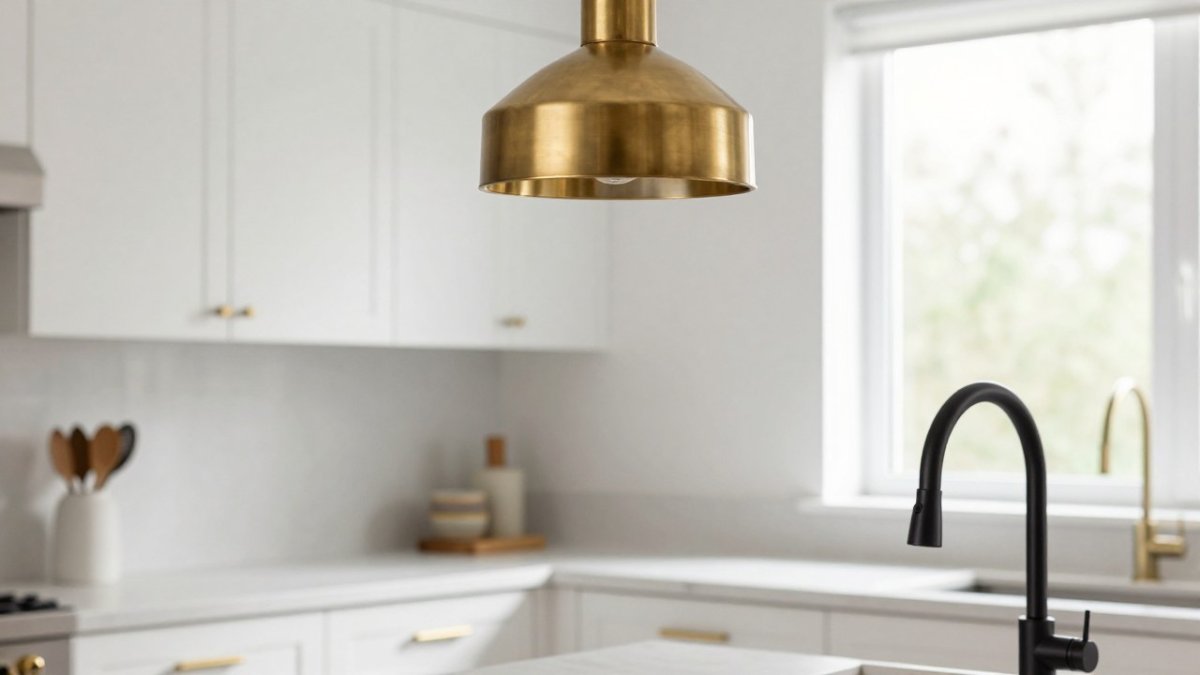
A practical coordination method:
- Match your faucet to your dominant finish
- Repeat the accent finish in the lighting fixtures
- Use the dominant finish again in cabinet hardware
Lighting deserves special attention because it changes how metal looks. Warm light makes brass glow, while cool daylight makes chrome and nickel look sharper.
Watch out: A pendant light that is much brighter or larger than the hardware can pull attention away from the rest of the room.
Mixing Metals Chart: Pairings That Work and Pairings to Avoid
Use this summary to check your choices quickly:
| Pairing | Result | Best Use |
|---|---|---|
| Brass and matte black | Strong contrast | Faucet and hardware on dark cabinets |
| Brushed nickel and polished chrome | Can look like a mismatch | Use in different zones, not side by side |
| Copper and stainless steel | Warm and cool balance | Accent copper in lighting or hardware |
| Gold and chrome | Mixed warm and cool | Limit gold to one or two small items |
| Three warm tones together | Often looks unplanned | Avoid unless one is clearly dominant |
Working With Existing Appliances, Fixed Finishes, and Durability
Most kitchens already include finishes you cannot easily change, such as stainless steel appliances, a sink, or a range hood. Plan your mix around these fixed elements rather than fighting them.
Start by listing every fixed finish in the room. Then choose your dominant and accent finishes to complement those items. If your appliances are stainless steel, a brushed nickel or chrome faucet usually sits comfortably beside them because all three share a cool, low-contrast tone.
Coordinating Around Stainless Steel Appliances
Stainless steel is the most common fixed finish, and it behaves like a cool neutral. A common pattern is to let stainless steel act as the dominant finish when appliances cover a large wall, then use warm brass or copper only in small accents such as cabinet pulls or a pendant. If you prefer a warm dominant finish, keep the stainless appliances visually separated from the warm hardware by a run of cabinet or backsplash so the two do not sit side by side.
Durability, Maintenance, and Patina
Finish choice affects daily cleaning more than most buyers expect. Compare these common behaviors before you commit:
- Polished chrome and polished nickel: Show fingerprints and water spots quickly, especially on faucets in hard-water areas. They wipe clean easily but need frequent attention to look their best.
- Brushed nickel and brushed stainless: Hide fingerprints and water spots better than polished finishes and are forgiving in busy kitchens.
- Matte black: Hides marks well but can show dust and light scratches on flat surfaces; touch-up is difficult, so choose it for pulls rather than high-contact faucets if you are rough on fixtures.
A practical rule is to put the finish that hides marks best on the items you touch most, such as the main faucet and the most-used cabinet pulls, and save the showier polished or unlacquered finishes for lighting and display areas.
Planning Around Fixed Finishes Over Time
If you are updating in phases, prioritize the items people see first: the main faucet, the cabinet pulls on the most visible run, and the primary light fixture.
Watch out: Do not choose a finish for a high-use faucet based only on how it looks in a showroom. Ask how it handles water spots and fingerprints in daily use, because a polished finish that looks striking on display can become a cleaning chore within weeks.
Booking Your Finish Plan With My Kitchen Design EXPO
Mixing metals well takes planning, and a professional eye can save time and mistakes. My Kitchen Design EXPO is a family-owned business serving Central Florida since 2009, and we offer one-stop design and turn-key construction services. Our team can show your finish choices in 3D before any work begins, so you can see how the metals look together.
To talk through your plan, click and make your "IN-STORE" appt today!
Frequently Asked Questions
How many metal finishes should you use in a kitchen?
Most kitchens work well with two or three metal finishes: one dominant finish that covers the largest surfaces, and one or two accents used in smaller doses. Using more than three tends to make the room look busy, especially when the finishes differ in sheen and undertone. Repeat each accent at least twice, such as a faucet and a pendant light, so the mix looks intentional rather than accidental. Appliances and fixed finishes like a stainless steel range count toward your total, so plan around them before choosing accents.
Can you mix brass and chrome in a kitchen?
Yes, but brass is warm and chrome is cool, so the contrast needs a bridge. Repeat each finish in at least two places, and let one of them be the dominant tone. A brass pendant over a chrome faucet can look deliberate when the rest of the room leans toward one side. Matte black or stainless steel often sits between the two and helps the pairing feel balanced. Check your samples under the actual kitchen lighting before committing, because warm bulbs push brass toward gold and cool bulbs make chrome look harsher.
Should kitchen cabinet hardware match the faucet?
Matching is not required. Hardware and faucets can share a finish family while differing slightly in tone, such as brushed nickel pulls with a polished nickel faucet, which reads as coordinated rather than identical. A safer approach is to pick one finish for the faucet and hardware together, then use a different metal for lighting as the accent. If you prefer contrast, choose hardware in the dominant finish and let the faucet carry a secondary tone. Ask the designer to review the full set of samples together in the room before ordering.
What are common mistakes when mixing metals in a kitchen?
The most frequent mistake is using too many finishes with no dominant tone, which makes the kitchen look scattered. Another is mixing finishes with different sheens, such as high-polish chrome next to a satin brass, without repeating either across the room. People also forget fixed finishes like a stainless steel range or existing appliances, then add accents that clash with them. Finally, buying finishes from different product lines often produces mismatched shades, so order the full set from one collection or verify samples side by side before installation.