 How-to
How to Organize Custom Home Office Cabinets
Table of Contents
- Start by Mapping What Goes Where in Your Home Office
- Step 1: Sort and Clear Out Your Office Supplies
- Step 2: Plan Zones Using the Cabinet Layout
- Step 3: Organize Your Home Office File Cabinet Layout
- Step 4: Set Up Office Supply Drawer Organizers
- DIY Home Office Cabinet Organization: Tools, Accessories and Pricing
- Keeping Your Custom Office Cabinets Organized Long Term
- Booking Your Custom Office Cabinet Design Consultation
- Frequently Asked Questions
Last Updated: November 19, 2026
Start by Mapping What Goes Where in Your Home Office
Before you start on how to organize custom home office cabinets, take a walk around the room and write down what you actually use every day. A step-by-step framework for planning the overall custom design process can help you think through the full project. Many people who work from a custom built-in desk find that a large share of their cabinet space holds supplies they haven't touched in a year. Mapping first keeps you from building a system around clutter.
Start with three columns on a sheet of paper: daily use, weekly use, and rarely used. Daily items belong at arm's reach, usually the lower drawers and the shelf nearest the desk. Weekly items can sit higher or deeper. Rarely used items, like tax files from several years back, belong in the highest or farthest spots.
- Daily: pens, notepads, the printer paper tray, phone charger
- Weekly: stapler, label maker, extra ink, mailing supplies
- Rarely used: holiday decorations, old manuals, backup cables
This quick map becomes your blueprint for every step that follows.
Step 1: Sort and Clear Out Your Office Supplies
Empty every cabinet before you organize anything. It feels slow, but it shows you exactly what you own and how much space you really have.
Work through the cabinets one at a time. Sort items into four piles: keep, donate, recycle, and trash. Dried-out markers, tangled cords with no matching device, and duplicate staplers usually go fast.
Watch out: Dispose of old batteries and printer toner at a proper drop-off, not in household trash (the EPA). Many office supply stores and local county programs accept them free.
Once the cabinets are empty and only the keep pile remains, wipe down the interior shelves, since learning how to organize custom home office cabinets starts with clean surfaces that make it easier to see what fits where.
Step 2: Plan Zones Using the Cabinet Layout
Divide your custom cabinetry into functional zones. A zone is simply a section of the cabinet dedicated to one type of task, such as paperwork, tech, or supplies.
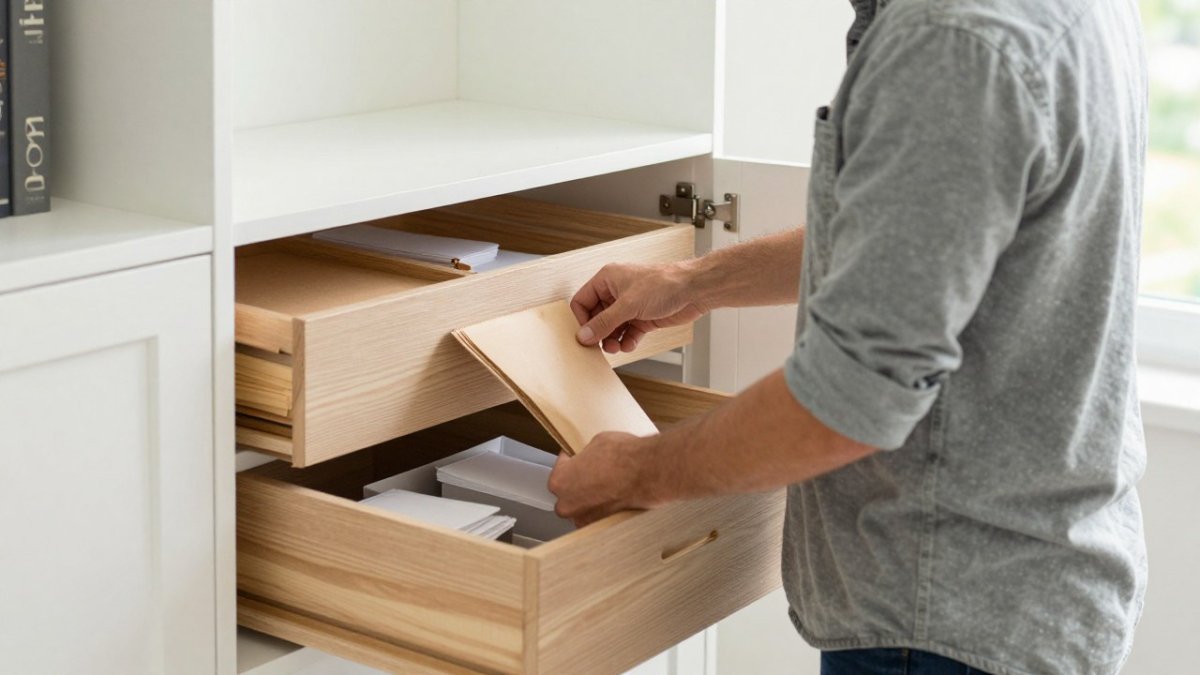
Most home offices work well with three zones. The paperwork zone holds active files and forms. The tech zone keeps chargers, cables, and hard drives together, ideally in a drawer with a cable pass-through. The supply zone stores pens, paper, and mailing materials.
Match each zone to the cabinet's location. Put the paperwork zone near the desk, the supply zone near the printer, and the tech zone where you charge devices. For tips on closet and storage design that apply to cabinetry interiors, see our Custom Closet Storage Design Tips: A Complete Guide.
Step 3: Organize Your Home Office File Cabinet Layout
Files are where most home offices get messy. A clear filing system saves time every time you need a document.
Use hanging folders with tabs for active records and place them in the top drawer for quick access. Store archived documents in the lower drawers, sorted by year. Keep a simple index card on the front of each drawer listing its contents.
- Group files by category: taxes, home, medical, and business
- Label each folder with the year and a short description
- Move completed years to a labeled storage box every January
A consistent system matters more than a perfect one. Pick a method and stick with it for three months before you change anything.
Step 4: Set Up Office Supply Drawer Organizers
Drawer dividers turn a jumbled drawer into a usable tool station. Adjustable inserts are the most flexible choice because you can resize compartments as your supplies change.
Measure each drawer's interior width and depth before you buy. Small dividers for pens, paper clips, and sticky notes keep small items from sliding into a single pile. Place a shallow tray near the front for items you grab every day.
For custom cabinetry, ask for organizers that match the cabinet depth. A standard insert that is too deep or too shallow will rattle and waste space. My Kitchen Design EXPO offers custom cabinetry and can be contacted to discuss planning interior storage for your project.
DIY Home Office Cabinet Organization: Tools, Accessories and Pricing
You can organize custom office cabinets yourself with a short tool list and a clear shopping plan. The work is mostly measuring, sorting, and labeling rather than construction, so most homeowners finish a single-wall office cabinet run in a weekend.
Tools you actually need
- Tape measure (a 16-foot blade is enough for most cabinet runs)
- Spirit level (a 9-inch torpedo level fits inside drawers)
- Cordless drill with a 1/8-inch bit for pilot holes
- Stud finder if you plan to mount rails or under-shelf lighting
- Label maker or a permanent marker and painter's tape
- Screwdriver set for adjusting hinges and drawer glides
Accessories that earn their space
Adjustable drawer dividers are the most flexible insert because compartments resize as supplies change. Look for dividers with spring-loaded or screw-tightened ends so they grip the drawer interior without drilling. Bamboo and coated steel are common materials; bamboo is lighter and quieter, steel holds heavier items like hole punches and staplers.
Pull-out trays convert deep lower cabinets into usable storage. A full-extension slide rated for 75 to 100 pounds handles reams of paper and binders without sagging. Measure the cabinet's interior depth and subtract at least 1 inch for the slide mechanism and door clearance.
Cable management grommets (typically 2 to 3 inches in diameter) let you route charging cords through a shelf or drawer back without pinching. Pair them with a surge protector mounted to the cabinet's interior back panel so devices charge out of sight.
Under-shelf task lighting comes in plug-in and hardwired versions. Plug-in LED strips are the simplest DIY option; hardwired versions require an electrician and are best planned during the cabinet build.
What things cost
Prices vary by brand, material, and quantity. Check current listings at the retailers you consider for accurate figures, and for pricing on custom cabinetry or organizers from My Kitchen Design EXPO, visit the company website or request a quote.
Watch out: A standard insert that is too deep or too shallow will rattle and waste space. Learn how to measure your cabinet space accurately before buying.
Digital-physical hybrid storage
Most guides stop at paper files, but modern home offices run on both. A practical hybrid system keeps the physical original only when the law or the situation requires it, signed contracts, tax returns, notarized documents, and anything you may need to hand to an accountant, and stores everything else digitally.
A simple method: scan incoming paper the day it arrives, name the file with a date-first convention (for example, 2026-11-19_utility-bill), and file the digital copy in a folder structure that mirrors your physical drawers.
If you want custom inserts or built-in organizers sized to your exact cabinet dimensions, visit the My Kitchen Design EXPO website or request a quote for current pricing.
The article's key tools and accessories, with what each one does for your cabinets:
| Item | Value | Note |
|---|---|---|
| Tape measure | 16-foot blade | Enough for most cabinet runs |
| Spirit level | 9-inch torpedo level | Fits inside drawers |
| Cordless drill | 1/8-inch bit | For pilot holes |
| Cable grommets | 2 to 3 inches diameter | Route charging cords through shelves |
| Full-extension slide | 75 to 100 pounds rating | Handles reams of paper and binders |
| Slide clearance | At least 1 inch subtracted from depth | For slide mechanism and door clearance |
| Daily-use reach range | Roughly 15 to 48 inches off floor | Easy reach without bending or stretching |
Keeping Your Custom Office Cabinets Organized Long Term
Most organization guides stop at the initial setup. The harder problem is month 13, when supplies have drifted, files have piled up, and the system you built no longer matches how you work. A maintenance routine built around a calendar keeps custom cabinets functional for years.
The weekly 15-minute reset
Set a recurring 15-minute block, Friday afternoon works for most people, to return items to their zones, clear the desk surface, and empty the shredder or recycling bin. Keep a small "return to zone" tray on the desk during the week so stray items have a home until the reset.
The monthly drawer audit
Once a month, open one drawer or cabinet section and check it against its index card. Move anything that has drifted out of its zone, recycle paper you no longer need, and note supplies running low so you can reorder before you run out.
The quarterly seasonal rotation
Four times a year, rotate items between the highest and lowest shelves. Seasonal items, holiday cards, tax-season forms, backup cables, move to the top or bottom, while active items come back to arm's reach. Label the rotation date on the storage box so you know when it was last touched.
The annual deep clean and purge
Once a year, empty each cabinet, wipe the interior with a soft cloth and mild cleaner, and check hardware: tighten drawer glides, adjust hinges, and look for sagging shelves. Avoid harsh chemicals that can dull finishes on custom wood. This is also the time to purge scanned originals that no longer need a physical copy and to update your digital-physical index.
Watch out: Paper and toner stored in a hot garage or against an exterior wall can warp, fade, or jam. Keep sensitive files and printer supplies on interior walls away from direct sun and heat sources.
Accessibility and universal design
A maintenance system only works if everyone using the office can reach it. For users with mobility limitations, keep daily items between roughly 15 and 48 inches off the floor, the range most adults can reach without bending or stretching (Chapter 3: Operable Parts).
Sustainable upkeep
When replacing inserts or organizers, choose materials with low off-gassing, bamboo, FSC-certified wood, or powder-coated steel, and avoid adhesives with strong solvent smells in enclosed cabinets. Reusable dividers and trays outlast disposable plastic bins and keep the system consistent year to year.
A consistent routine matters more than a perfect one. Pick a schedule and stick with it for three months before you change anything.
Booking Your Custom Office Cabinet Design Consultation
Organizing a home office is easier when the cabinets are designed for your workflow from the start. A custom design session lets you plan zones, drawers, and inserts before anything is built.
The team at My Kitchen Design EXPO has served Central Florida since 2009 and offers 3D visualization so you can see your project before construction begins. Read how the custom cabinet design process works, step by step before you book. Click and make your "IN-STORE" appointment today to start planning your space.
Frequently Asked Questions
What is the 1/3 rule for cabinets, and does it apply to office storage?
The 1/3 rule is a common guideline suggesting that a cabinet or drawer should be filled no more than about one-third with items to leave room to find things and add new ones without crowding. It applies well to home office storage, especially file drawers and supply cabinets, where overpacking makes folders hard to pull out and supplies hard to see. Leaving open space in each zone also makes it easier to adjust your layout as your paperwork and equipment change over time.
Why should you only open one file drawer at a time?
Custom file cabinets are often built to sit on a single track or frame, and opening more than one drawer at once can cause the cabinet to tip, especially in floor-standing units. Opening one drawer at a time keeps the unit stable and protects drawer slides and hardware. It is a simple habit that extends the life of your custom cabinetry and keeps the unit safe for everyone using the office.
How can I organize office supplies in cabinet drawers?
Start by grouping supplies by how often you use them, keeping daily items such as pens, sticky notes and scissors in the top drawer within easy reach. Use drawer dividers and small organizers sized to each drawer's depth and width, and reserve deeper drawers for bulk items like printer paper. Label each compartment so everything has a home, and check every few months to remove unused items and keep the system working.
What should I store in built-in office cabinets?
Built-in office cabinets work best for items you use regularly but do not need on the desk, such as files, printer supplies, backup electronics and seasonal materials. Keep frequently used items at eye and hand level, store heavier equipment on lower shelves, and place rarely used archives in upper cabinets. Planning storage around how often you reach for each item will make the cabinets far more functional day to day.