 Listicle
Best Countertop Materials for Busy Family Kitchens 2026
Table of Contents
- What Makes a Countertop Right for Busy Families
- Quartz vs Granite Countertops: Durability and Maintenance Compared
- Most Durable Kitchen Countertop Materials for Heavy Daily Cooking
- Best Low-Maintenance Kitchen Countertops for Real Family Life
- Budget-Friendly Kitchen Countertop Options Without Sacrificing Performance
- Countertop Comparison Table: Quick Reference for Your Decision
- Installation, Repair, and Long-Term Costs: What Families Need to Know
- How to Choose the Right Countertop Material for Your Family Kitchen
- Frequently Asked Questions
Last Updated: October 17, 2026
What Makes a Countertop Right for Busy Families
Choosing the best countertop materials for busy family kitchens means matching durability, maintenance demands, and your actual lifestyle. The best countertop materials for busy family kitchens in 2026 aren't the most expensive or trendy, they're the ones that survive spilled juice, dropped pans, and years of heavy daily cooking without constant upkeep.
At My Kitchen Design EXPO, we help families navigate this decision by focusing on what matters: how a surface performs under real-world stress. A countertop that thrives in a family kitchen comes down to three factors: nonporous surfaces that resist staining, heat resistance for cooking, and honest maintenance requirements.
Most guides oversell beauty and undersell practicality. Marble looks stunning in a showroom but chips easily and stains when your kids make pancakes. Laminate is budget-friendly but won't survive a decade of daily wear. The sweet spot for busy families sits between durability and realistic maintenance, surfaces that forgive occasional neglect without requiring professional sealing every few years.
Below, we'll walk through the top contenders, what each material actually costs, what can go wrong, and which families each one truly serves best.
Quartz vs Granite Countertops: Durability and Maintenance Compared
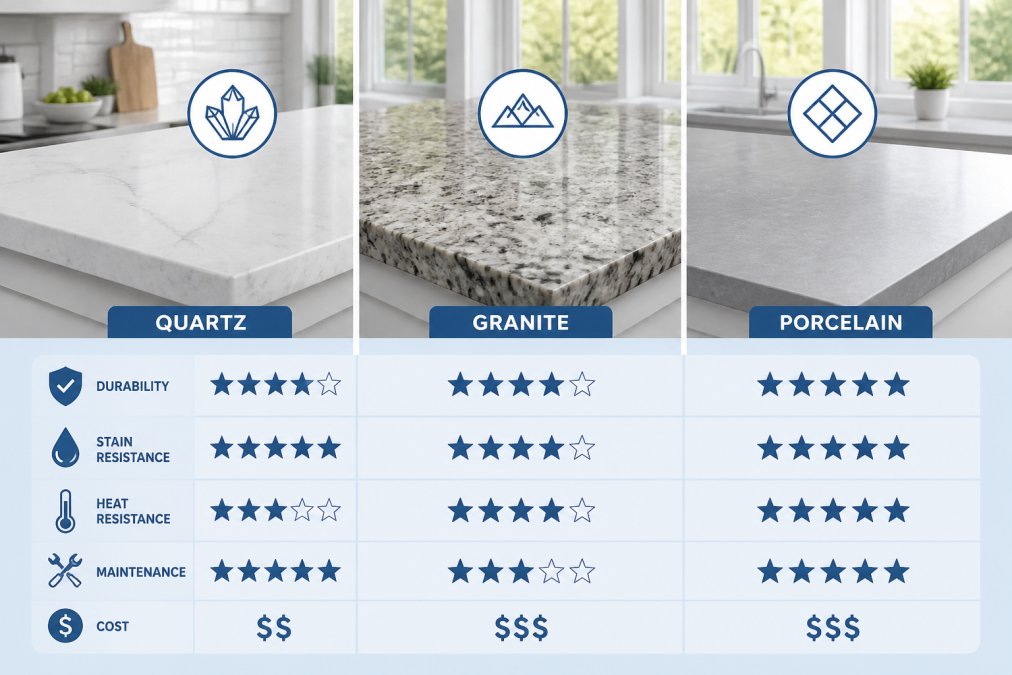
Quartz has become the default recommendation for busy families, and for good reason, but granite still has legitimate advantages if you prioritize heat resistance and natural variation.
Quartz countertops are engineered from crushed stone bound with resin, creating a nonporous surface that doesn't require sealing. Granite needs resealing every 1-3 years, which means ongoing costs and the risk of forgetting and ending up with stained stone. Quartz eliminates that worry: spilled wine, tomato sauce, or coffee won't penetrate, and daily cleaning is just soap and water. For families with young kids or busy schedules, that's real peace of mind.
Quartz also offers consistency: every slab looks similar, so matching a repair or replacement section is straightforward, with no surprises.
The tradeoff: quartz isn't as heat-resistant as granite. A hot pan placed directly on quartz can mark or damage the resin, so you'll need trivets and hot pads.
Granite countertops are natural stone, so each slab is unique, no two kitchens look identical. Granite is also genuinely heat-resistant: you can place a hot skillet down without worry. For families who cook frequently and value thermal durability, granite wins this round.
The maintenance reality: granite requires sealing to stay stain-resistant. Without it, acidic liquids (lemon juice, vinegar, wine) can etch the surface. Sealing isn't difficult, but busy families sometimes forget, and then stains happen.
Granite is also softer than quartz, so it chips more easily: drop a heavy pot on granite and you might get a visible chip.
For busy families, the choice comes down to this: want zero maintenance headaches and don't mind trivets, choose quartz. Cook constantly, don't mind resealing every couple of years, and value natural stone's uniqueness, granite remains excellent.
Most Durable Kitchen Countertop Materials for Heavy Daily Cooking
When a kitchen sees serious use, multiple meals a day, frequent entertaining, or a household where someone is always cooking, durability becomes the primary filter.
Porcelain countertops have emerged as a serious contender for heavy-use kitchens. Fired at extremely high temperatures, porcelain is harder than granite and more scratch-resistant than quartz. It handles heat well, resists stains without sealing, and stands up to daily abuse.
Porcelain is also nonporous, so bacteria and food residue don't penetrate.
The practical downside: porcelain is less forgiving if you need repairs. If a section cracks or chips, matching becomes difficult because each porcelain slab has subtle color variation. Installation is also more specialized, so labor costs can be higher.
Quartzite sits between granite and quartz in durability. It's a natural stone but denser and harder, resisting scratches better than granite, handling heat well, and developing a beautiful patina over time. For families that want natural stone durability, quartzite is worth considering.
Quartzite does require sealing like granite, so the maintenance equation is similar. It's also more expensive than quartz, positioning it as a premium choice for families that prioritize longevity and aesthetics equally.
Stainless steel deserves mention where heavy cooking is the priority. Professional kitchens use it because it handles heat, resists bacteria, survives constant use, and is easy to sanitize. For a family that cooks restaurant-style meals regularly, stainless steel offers unmatched durability and food-safety performance.
The reality check: stainless steel shows fingerprints constantly, requires regular polishing to maintain its appearance, and can be noisy (pots and pans rattle against it). It also dents and scratches visibly. For busy families that prioritize function over appearance, it works. For families that want their kitchen to look polished, it's demanding.
Best Low-Maintenance Kitchen Countertops for Real Family Life
Low-maintenance doesn't mean no maintenance, it means the surface forgives neglect and doesn't demand special treatment.
Quartz remains the gold standard for low-maintenance family kitchens because it asks almost nothing of you: no sealing, no special cleaners, no worrying about stains. Wipe it down with soap and water and you're done, a simplicity worth the premium price.
Laminate and Formica represent the true low-maintenance budget option: no sealing, reasonable stain resistance, and easy cleaning. The tradeoff is durability, since laminate doesn't survive heat well, scratches easily, and typically lasts 10-15 years.
Laminate also comes in hundreds of designs that mimic natural stone or wood, so aesthetic options are broader than many assume. If you're willing to replace it in a decade, laminate is a legitimate low-maintenance choice.
Click and Make your "IN-STORE" appt today! →
Solid surface materials (like Corian) bridge the gap between laminate and stone: nonporous, minimal maintenance, stain-resistant, and professionally repairable if damaged. They don't handle heat as well as stone but are far more forgiving than laminate, making solid surface an underrated choice for families wanting durability without natural stone's sealing and maintenance.
Budget-Friendly Kitchen Countertop Options Without Sacrificing Performance
Not every family has a premium budget, and that's fine. Several materials deliver solid performance at accessible price points.
Laminate is the entry-level choice: affordable, easy to install, and available in nearly unlimited designs. It won't last as long as stone or quartz but performs adequately for 10-15 years with normal use, making financial sense for families planning to renovate again in a decade or for rental properties.
Solid surface materials offer better performance than laminate at a moderate price: more durable, easier to repair, and more resistant to heat and stains. If you can stretch beyond basic laminate but don't have a quartz budget, solid surface is worth it.
Cultured marble is a budget alternative to natural marble that mimics the look without the maintenance: nonporous, no sealing required, and more affordable than the real thing.
Ceramic tile is another budget-friendly option, durable and easy to replace if individual tiles crack. The grout requires maintenance to prevent staining, but tile itself is forgiving, working well for families comfortable with a utilitarian look.
The honest budget truth: you can get functional, attractive countertops that perform adequately for 10-15 years. The key is matching your budget to realistic expectations about longevity.
Countertop Comparison Table: Quick Reference for Your Decision
| Material | Heat Resistance | Stain Resistance | Sealing Required | Best For | Typical Lifespan |
|---|---|---|---|---|---|
| Quartz | Good (use trivets) | Excellent | No | Low-maintenance families | 25+ years |
| Granite | Excellent | Good | Yes (1-3 years) | Heat-focused cooks | 25+ years |
| Porcelain | Excellent | Excellent | No | Heavy daily use | 25+ years |
| Quartzite | Excellent | Good | Yes (1-3 years) | Natural stone lovers | 25+ years |
| Marble | Fair | Poor | Yes (1-2 years) | Aesthetic priority | 20+ years |
| Stainless Steel | Excellent | Excellent | No | Professional cooks | 20+ years |
| Laminate | Poor | Fair | No | Budget-conscious | 10-15 years |
| Solid Surface | Fair | Good | No | Budget-moderate | 15-20 years |
| Ceramic Tile | Good | Fair | Grout maintenance | Utilitarian look | 15-20 years |
Installation, Repair, and Long-Term Costs: What Families Need to Know
The purchase price of countertop material tells only part of the story. Installation, repairs, and replacement costs matter equally for busy families planning a long-term kitchen.
Installation complexity varies. Laminate and solid surface are straightforward for most contractors. Quartz and granite require precision cutting and professional installation because mistakes are expensive. Porcelain demands even more specialization because it's brittle and needs specific cutting tools. When comparing quotes, factor in labor costs, which vary by material difficulty.
Repair and replacement is where material choice becomes financially meaningful. Quartz is monolithic, so a chip or crack usually means replacing the entire countertop because matching a repair is nearly impossible. Granite can be professionally repaired with epoxy or resin, but repairs are visible, and porcelain repairs are similarly challenging.
Sealing costs for granite and quartzite add up over time. A professional seal typically lasts 1-3 years. Over 25 years, that's multiple resealing cycles, a real recurring expense that busy families often forget to budget for.
Lifecycle replacement is the biggest financial consideration. Laminate might need replacement in 12-15 years, while quartz, granite, and porcelain typically last 25+ years. If you're staying long-term, premium materials pay for themselves through longevity; if you're moving or renovating in a decade, budget options make more sense.
How to Choose the Right Countertop Material for Your Family Kitchen
Start by answering these questions honestly:
How much do you cook? If multiple meals a day happen in your kitchen, heat resistance and durability matter most. Porcelain or granite. If cooking is occasional, quartz or laminate work fine.
How much maintenance are you willing to do? If annual sealing feels like a chore you'll skip, choose quartz or porcelain (no sealing required). If you enjoy home maintenance, granite or quartzite are fine.
How long are you staying? Moving or renovating in 10 years, laminate or solid surface make financial sense. Staying 20+ years, invest in quartz, granite, or porcelain.
What's your actual budget? Don't stretch beyond comfort for aesthetics: a laminate countertop you can afford beats granite you're stressed about affording.
Do you have kids or pets? Durable, forgiving surfaces (quartz, porcelain, laminate) handle spills and accidents better than marble or stainless steel.
My Kitchen Design EXPO helps families answer these questions with 3D virtual design modeling, so you can see exactly how different materials look in your kitchen, under your lighting, with your cabinets and appliances. That visualization eliminates guesswork and helps you choose confidently.
The right countertop material for your busy family kitchen isn't the most expensive or trendy, it's the one that matches your cooking style, maintenance tolerance, budget, and timeline. Honest self-assessment beats marketing hype every time.
Choosing countertop materials for a busy family kitchen involves balancing durability, maintenance, and cost across multiple options. My Kitchen Design EXPO offers turn-key design and construction services that include custom cabinetry, granite or quartz countertops, and advanced 3D virtual modeling so you can see your kitchen design before construction begins. Our team provides expert guidance to help you make intelligent material choices that match your family's actual needs. Click and make your in-store appointment today to start your kitchen transformation with a design consultation.
Frequently Asked Questions
Is quartz or granite better for a busy kitchen?
Quartz is typically better for busy kitchens because it's nonporous and requires no sealing, making it easier to clean and more resistant to staining. Granite offers superior heat resistance and natural beauty but needs periodic sealing and more maintenance. The choice depends on whether you prioritize low maintenance (quartz) or heat resistance and natural stone appearance (granite). Both are durable for family use.
Which kitchen countertops are easiest to maintain?
Quartz and porcelain are the easiest to maintain among best low-maintenance kitchen countertops. Both are nonporous, don't require sealing, and resist stains and scratches. Daily cleaning requires only mild soap and water. Laminate is also low-maintenance but less durable for heavy use. Granite and marble need regular sealing and more careful cleaning to prevent damage.
What countertop material resists stains and scratches best?
Quartz and porcelain are the most durable kitchen countertop materials for stain and scratch resistance. Both are engineered to resist damage from everyday kitchen use, including acidic foods, heat, and impact. Granite is naturally heat-resistant but more prone to staining without sealing. Quartzite offers natural stone durability but requires maintenance. Laminate scratches easily and isn't ideal for busy families.
What budget-friendly kitchen countertop options work for families?
Laminate and solid surface materials are the most affordable budget-friendly kitchen countertop options. Laminate has lower durability. Engineered quartz provides better performance than laminate. Porcelain slabs offer excellent durability, making them a smart value choice for busy kitchens.