 Comparison
Quartz vs Granite Countertops for Kitchen: 2026 Guide
Table of Contents
- Quartz vs Granite Countertops for Kitchen: A Side-by-Side Comparison
- Quartz vs Granite Countertops Durability: Scratch, Chip, and Heat Resistance
- Quartz vs Granite Cost: Installed Price and Lifetime Value
- Quartz Countertop Maintenance: Cleaning, Stains, and Daily Care
- Granite Countertop Sealing: Why Natural Stone Needs More Attention
- Appearance, UV Resistance, and How Each Surface Ages
- Repairs, Environmental Impact, and Kitchen Decision Scenarios
- Conclusion: Choosing the Right Countertop for Your Kitchen
- Frequently Asked Questions
Last Updated: October 12, 2026
Quartz vs Granite Countertops for Kitchen: A Side-by-Side Comparison
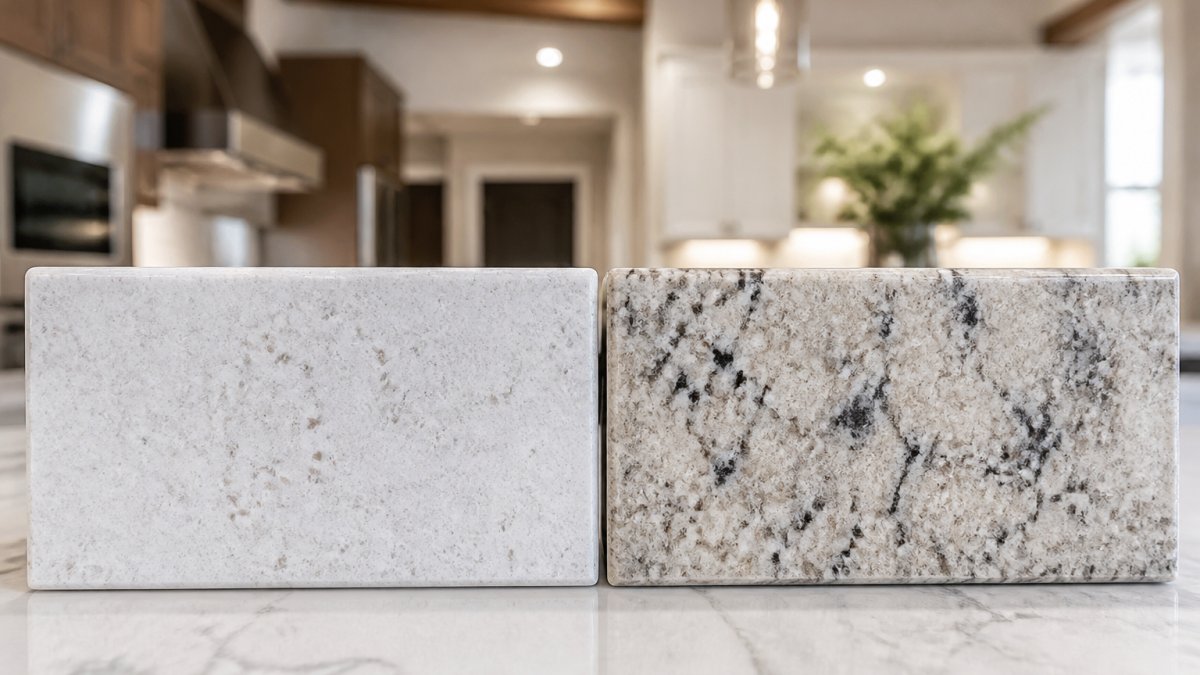
Choosing between quartz vs granite countertops for kitchen projects comes down to one practical split: quartz is engineered for uniformity and low maintenance, while granite is mined stone valued for one-of-a-kind character.
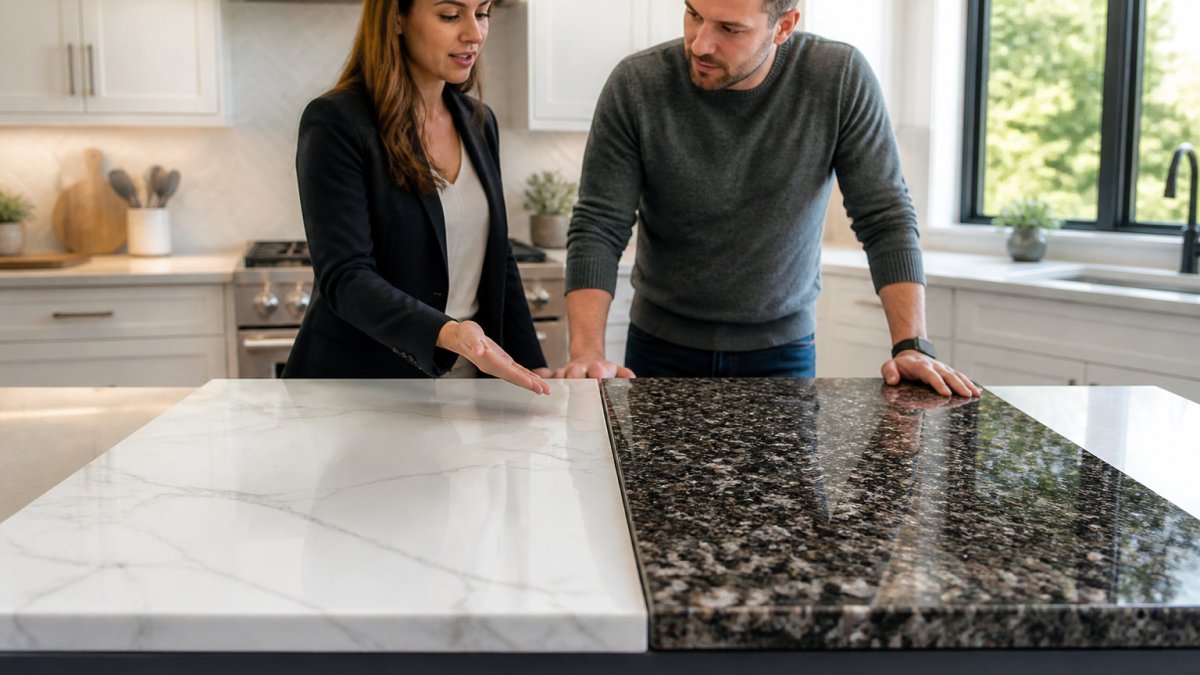
Most guides frame this as a durability contest. It is really a maintenance-and-lifestyle decision. Below, we break down composition, durability, cost, care, and repair.
What Quartz and Granite Are Made Of
Quartz countertops are engineered stone: roughly 90 to 95 percent ground quartz crystals bound with resin, pigments, and polymers, then formed into slabs under pressure and heat.
Granite countertops are natural stone, mined as blocks and cut into slabs. Each slab carries its own mineral mix, so veining, color, and speckling vary from piece to piece and even across a single slab.
That single difference, manufactured versus mined, drives nearly every other trade-off in this comparison.
Natural Stone vs Engineered Stone
Granite's mineral structure makes it hard and heat-tolerant, but its tiny pores can absorb spills. Quartz's resin binder blocks absorption, though the resin limits how much heat the surface can take.
- Granite: unique appearance, needs sealing, handles hot cookware well
- Quartz: uniform appearance, no sealing, needs trivets under hot pans
- Granite: repairable chips can be filled and blended by a fabricator
Neither is "better" in the abstract. They simply fail in different ways.
Quartz vs Granite Countertops Durability: Scratch, Chip, and Heat Resistance
Quartz vs granite countertops durability is closer than most buyers expect, but the weak points differ. Quartz resists scratches and chips better; granite resists heat better.
On the Mohs hardness scale, granite ranks around 6 to 7 and quartz around 7, so both shrug off knife marks and normal abrasion.
Heat is the reverse story. Granite is formed under intense geological heat, so a hot pot rarely damages it.
Hot Pots, Pans, and Trivets: What Each Surface Tolerates
Granite tolerates hot pots and pans placed directly on the surface, though we still recommend trivets to protect the finish and avoid thermal shock at seams. Quartz does not. Set hot cookware on a trivet or a cooling rack every time.
Quartz vs Granite Cost: Installed Price and Lifetime Value
Quartz vs granite cost is the question buyers ask first and understand last, because the number that matters is not the slab price, it is the installed price plus what you spend keeping the surface serviceable. Most published ranges blur those two figures, which is why two quotes for the "same" kitchen can differ by thousands.
What Actually Goes Into an Installed Quote
A countertop quote is a stack of line items, not a single rate. Make sure each bid breaks out:
- Material, priced per square foot, and slab grades vary widely within both quartz and granite. A builder-grade granite and an exotic book-matched slab are different products, not the same product at different prices.
- Template and measurement, a technician measures on site after cabinets are set. Skipping this step leads to seams in the wrong place.
- Fabrication, cutting, polishing, and shaping. Complex layouts, waterfall edges, and curved islands add labor.
The material line is the most visible number and the least predictive of the final invoice. Ask for the full breakdown in writing before you sign.
Regional and Slab-Grade Caveats
Countertop pricing is local. Labor rates, freight distance, and local competition all move the number. A slab common in one market may be a special order in another, and special orders carry freight surcharges.
Treat any national range as a starting point, not a budget. Get at least three local quotes on the same slab and edge profile so you compare like for like.
Lifecycle Cost: What You Spend After Install
The upfront quote is only the first cost. Over ten years, the two materials diverge predictably:
| Cost category | Quartz | Granite |
|---|---|---|
| Sealer and resealing | None required | Recurring, every one to three years |
| Specialty cleaners | Mild soap and water | Mild soap and water, plus sealer |
| Chip or crack repair | Harder to color-match; may require section replacement | Often fillable and blendable by a fabricator |
| Heat damage risk | Trivet discipline required; scorch can mean section replacement | Low risk under normal use |
| Replacement | Full section or slab if damage is severe | Full section or slab if damage is severe |
The biggest lifecycle swing is not sealer, it is damage. A scorch ring on quartz or a seam crack on either material can turn a repair into a partial replacement, which is expensive because the fabricator must match a slab that may no longer be in production. That is why we tell clients to buy one extra slab or reserve a remnant from the same lot if the layout allows.
Marble Systems' countertop cost comparison
Quartz Countertop Maintenance: Cleaning, Stains, and Daily Care
Quartz countertop maintenance is simple: wipe with mild soap and water or a non-abrasive cleaner. Because quartz is nonporous, spills sit on the surface instead of soaking in, making stain resistance a top selling point.
Avoid abrasive pads, scouring powders, and bleach or high-acid cleaners, which dull the finish over time. A soft cloth and dish soap handle almost everything.
- Wipe spills promptly, especially wine, oil, and tomato
- Use a cutting board rather than cutting directly on the surface
- Skip ammonia-based and abrasive cleaners
Granite needs similar daily cleaning but adds one recurring task: sealing.
Click and Make your "IN-STORE" appt today! →
Granite Countertop Sealing: Why Natural Stone Needs More Attention
Granite countertop sealing is the maintenance step quartz owners never deal with. Granite is porous, so a penetrating sealer fills the microscopic gaps between minerals and slows liquid absorption.
Most fabricators recommend resealing every one to three years, depending on porosity and use.
Sealing is not difficult, clean, apply evenly, let sit, wipe off excess. The catch is remembering, which is why busy households often lean toward quartz.
Appearance, UV Resistance, and How Each Surface Ages
Granite wins on character; quartz wins on predictability. Every granite slab is unique, with natural variation no engineered product can fully replicate. Quartz offers uniform appearance and consistent color across slabs, which matters for a seamless look or a specific shade.
UV resistance is a real differentiator. Quartz can fade or yellow with prolonged sunlight exposure, so it is a poor fit for outdoor kitchens or sun-drenched spaces. ARC Surfaces' quartz vs granite guide notes this contrast directly, flagging quartz's chip and stain resistance against granite's heat tolerance.
Both come in polished, honed, and matte finishes, and the edge profile shapes the final look as much as the slab does.
Repairs, Environmental Impact, and Kitchen Decision Scenarios
What happens when something goes wrong, where the material comes from, and how you cook determine which surface you will be happier with in year five.
Repairability and Damage Scenarios
Both materials can be damaged. The difference is what the repair looks like.
- Chip on granite, A fabricator fills the chip with color-matched epoxy, sands it flush, and polishes it. On speckled or heavily patterned granite the repair often disappears; on solid or tightly veined granite it is visible up close but blends from standing height.
- Chip on quartz, Same technique, but the engineered pattern is the problem. Solid-color quartz hides a fill well; veined or marbled quartz rarely matches because the pattern cannot be recreated in epoxy. Many quartz chips end up as a visible patch or section replacement.
- Crack at a seam, Seams are the most common failure point on both. An opening seam can usually be re-epoxied and re-polished. A crack through the slab body is a fabricator job on granite and often a replacement on quartz.
A pattern we see: granite damage is usually repairable, quartz damage is usually replaceable. That is not a knock on quartz, it is a reason to use trivets and cutting boards religiously if you choose it.
Environmental Impact and Sourcing
Neither material is automatically greener; it depends on the specific product and how far it traveled.
- Granite is quarried, cut into blocks, and shipped as heavy slabs. Quarrying disturbs land and slab freight is energy-intensive because stone is dense. But granite is finished the moment it is cut and polished, no resin, no curing ovens.
- Quartz is manufactured: mining quartz crystals, producing resin (typically petrochemical), and curing slabs with heat and pressure. The footprint is real, but engineered slabs can be made closer to the point of sale and can incorporate recycled content.
If sustainability matters, ask the fabricator or dealer for product documentation. Many manufacturers publish environmental product declarations (EPDs) or health product declarations (HPDs) disclosing recycled content, emissions, and sourcing. Ask about recycled content percentage, where the raw material is quarried or produced, and any third-party certification.
Kitchen Decision Scenarios
How we would steer different households:
- Heavy cooks who use high heat, Granite. Cast iron, woks, and sheet pans straight from the oven are not a threat. If you choose quartz, budget for trivets and a landing zone next to the range.
- Busy families wanting low upkeep, Quartz. No sealing, no water test, no remembering. Spills wipe up.
- Outdoor or sun-exposed kitchens, Granite. Quartz can fade or yellow under prolonged UV exposure.
ARC Surfaces' quartz vs granite guide
Conclusion: Choosing the Right Countertop for Your Kitchen
Both materials perform well when matched to the right kitchen; the wrong match creates daily frustration. For low maintenance and a uniform look, quartz is our recommendation.
My Kitchen Design EXPO handles that decision end to end as a one-stop shop, from custom cabinetry to granite or quartz countertops, with 3D virtual design visualization so you see the finished kitchen before construction begins.
Frequently Asked Questions
Should I put granite or quartz in my kitchen?
It depends on what you value most. Granite handles heat better and each slab is unique, but it needs periodic sealing and can chip. Quartz resists stains and chips, needs no sealing, and offers a consistent look, but it can discolor with prolonged sunlight and is less heat-tolerant. For busy kitchens where low maintenance matters most, quartz is often the easier choice. If you want one-of-a-kind natural stone and don't mind occasional sealing, granite works well.
Which is more durable for kitchen countertops, quartz or granite?
Both are hard, durable surfaces, but they fail differently. Granite is natural stone that resists heat well, yet it can chip at edges and absorbs stains if unsealed. Quartz is engineered stone mixed with resin, so it resists scratches, chips, and stains better, but it can be damaged by prolonged heat from hot pots and pans. Durability comes down to how you use the kitchen: quartz for stain and chip resistance, granite for heat tolerance.
Does granite need to be sealed more often than quartz?
Yes. Granite is porous natural stone and requires sealing to block stains and moisture, typically every one to two years depending on use and the specific slab. Quartz is a nonporous engineered surface and never needs sealing. If you want to skip the resealing routine entirely, quartz countertop maintenance is simpler. If you choose granite, plan on periodic granite countertop sealing to keep it protected.
Can hot pans damage quartz or granite countertops?
Granite tolerates hot pots and pans better because it is natural stone. Quartz contains resin, which can scorch, discolor, or crack under direct high heat. With either surface, use trivets or hot pads as a habit. Quartz manufacturers typically recommend never placing hot cookware directly on the surface. Even granite benefits from trivets to avoid thermal shock, especially at seams and edges.
Which costs more, quartz or granite countertops?
Reported ranges overlap, so neither is universally cheaper. Your final quartz vs granite cost depends on slab selection, edge profile, cutouts, and fabrication details. Request a project-specific quote before budgeting.
Picking a countertop is really a bet on how you will live in your kitchen for the next decade, and guessing wrong is expensive. My Kitchen Design EXPO removes that guesswork with turn-key construction services, a one-stop shop that eliminates coordinating separate trades, and 3D virtual design visualization so you approve the exact look before we build it. Get started with My Kitchen Design EXPO and see your kitchen in 3D before construction begins.