 Ultimate guide
Best Kitchen Cabinet Materials for Durability
Last Updated: November 5, 2026
Quick Summary
Plywood and solid hardwood are the most durable cabinet materials, with plywood cores resisting moisture and holding screws far better than particleboard. Pair a plywood box with high-pressure laminate or a factory-cured finish on the doors for the longest service life.
- Solid hardwood doors can be sanded and refinished repeatedly, which is why they can last decades.
- Particleboard swells when water reaches the raw edge and never returns to its original shape.
- High-pressure laminate fuses multiple resin-soaked layers under intense heat and pressure for strong scratch resistance.
- Custom builds let you specify a plywood core, solid hardwood faces, and better joinery from the start.
- A slow leak under the sink is the single most common failure pattern in kitchens.
Table of Contents
- How We Rated Cabinet Materials for Durability
- Solid Wood vs Engineered Wood: Which Lasts Longer
- Plywood vs Particleboard Cabinets: The Core Matters
- High-Pressure Laminate vs Low-Pressure Laminate
- Waterproof Material for Kitchen Cabinets: What Actually Works
- Custom vs Stock Kitchen Cabinets: Durability Trade-offs
- Repairability and Real-World Stress Testing
- Book a 3D Design Consultation for Your Kitchen
- Frequently Asked Questions
How We Rated Cabinet Materials for Durability
Plywood and solid hardwood are widely regarded as durable choices for the cabinet box, paired with a high-pressure laminate or factory-cured finish on the doors.
Generally, the materials behind the door matter as much as the door itself. A painted front on a particleboard carcass can fail well before a plain plywood box.
We rated every material on four things: moisture resistance, structural integrity, repairability, and how well it survives a high-traffic kitchen. Here is the short version.
| Material | Moisture Resistance | Structural Strength | Repairability | Best For |
|---|---|---|---|---|
| Solid hardwood | Moderate | Excellent | Excellent | Long-term owners |
| Plywood core | High | Very good | Good | High-traffic kitchens |
| Moisture-resistant MDF | Moderate | Good | Fair | Painted finishes |
| Particleboard | Low | Fair | Poor | Tight budgets |
| High-pressure laminate | High | Good | Poor | Busy households |
| Low-pressure laminate | Moderate | Fair | Poor | Rentals |
For the full breakdown of every option on the market, see our guide to the best kitchen cabinet materials.
Solid Wood vs Engineered Wood: Which Lasts Longer
Solid wood is often associated with longer lifespan, while engineered wood is often associated with greater stability. A solid hardwood door can be sanded and refinished repeatedly, which is why it can last decades. The catch is movement: hardwood expands and contracts as humidity swings, so joints can open over time.
Engineered wood, meaning plywood, MDF, or particleboard, is manufactured to resist that movement. Plywood in particular holds its shape across temperature changes far better than a solid slab.
A common approach is solid wood for door fronts and visible faces, with plywood for the cabinet box. If you are weighing a full custom build against a ready-made option, our comparison of custom vs stock kitchen cabinets covers how each handles that mix.
Plywood vs Particleboard Cabinets: The Core Matters
Plywood cabinets are generally considered more durable than particleboard cabinets in several key categories. Plywood is built from layered wood veneers glued in alternating directions, which gives it high screw-holding capacity and real resistance to moisture. Particleboard is compressed wood dust and resin; it is cheaper, but it swells when water reaches the raw edge and never returns to its original shape.
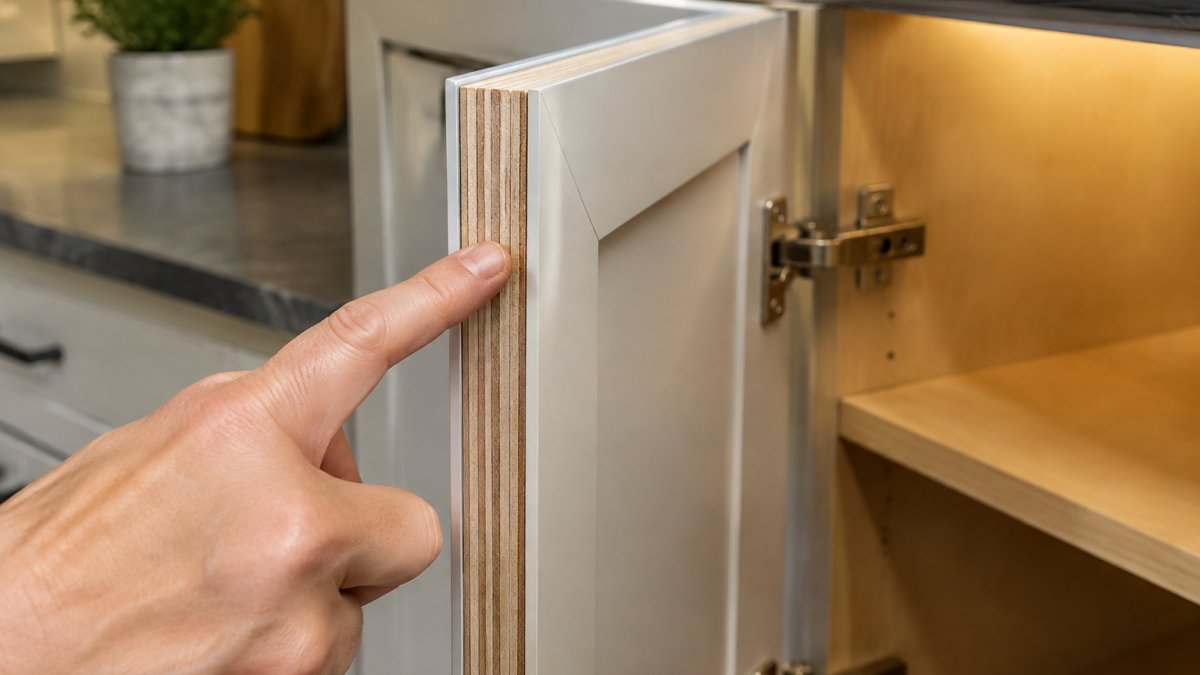
Hinges and drawer glides are a useful place to look. Screws in particleboard can strip out over time, while plywood cores generally hold screws more firmly. Ask what the cabinet box is made of before you ask about the door color.
High-Pressure Laminate vs Low-Pressure Laminate
High-pressure laminate is the tougher of the two, and the difference comes down to how the surface is bonded. HPL fuses multiple resin-soaked layers under intense heat and pressure, producing a dense skin with strong scratch resistance and heat tolerance. LPL uses a single layer bonded with less pressure, so it costs less but chips and scuffs more easily.
Where each fits:
- HPL: family kitchens, rental units that take abuse, anywhere near the range
- LPL: cabinet interiors, budget renovations, low-traffic second homes
One honest limitation: neither laminate repairs cleanly. A chipped edge on HPL is hard to disguise, while a solid wood face can be sanded and refinished.
Waterproof Material for Kitchen Cabinets: What Actually Works
No cabinet material is truly waterproof, but plywood and high-pressure laminate come closest to a waterproof material for kitchen cabinets. Plywood resists moisture penetration far better than particleboard or standard MDF, and an HPL surface is non-porous, so spills sit on top instead of soaking in.
Moisture-resistant MDF improves on standard MDF with water-repellent resins, but it still swells if water gets past the finish. That is why we specify sealed edges and proper caulking around sinks.
Watch out: the most common failure we see is a slow leak under the sink wicking into an unsealed cabinet bottom. By the time the swelling shows, the box is already compromised.
Custom vs Stock Kitchen Cabinets: Durability Trade-offs
Custom cabinets usually outlast stock cabinets because you control the materials, not just the dimensions. Stock cabinets are built to a price point, and that often means particleboard boxes and LPL fronts.
Click and Make your "IN-STORE" appt today! →
The more useful comparison is cost versus longevity. A stock cabinet with a particleboard box may cost less up front, but the failure modes show up early: hinge screws strip, the box swells at the sink base, and the LPL front chips at the edges.
When you compare quotes, ask for these specifications in writing:
- Box material: plywood versus particleboard versus MDF, and the nominal thickness.
- Joinery: dowel, dado, or cam-and-dowel construction versus stapled butt joints.
- Drawer boxes: dovetail or doweled hardwood versus stapled or glued particleboard.
- Glides and hinges: brand, load rating, and whether they are soft-close and adjustable.
- Edge banding: PVC, ABS, or wood veneer, and how the edges are sealed.
- Finish: factory-cured versus site-applied, and the warranty terms on the finish.
Hardware quality deserves its own line because it drives durability as much as the box does. A plywood cabinet with cheap hinges will still fail at the hinge line; a mid-grade cabinet with quality adjustable hinges and full-extension glides will outlast its price class.
Watch out: a stock cabinet with a plywood box and quality hardware can beat a custom cabinet built with a particleboard box and budget glides, so do not assume the custom label guarantees a better build.
If budget is the deciding factor, our guide to getting custom kitchen cabinetry quotes shows what to ask so you are comparing like for like. For a full project budget, review our custom cabinetry installation cost guide before you commit to either path.
Repairability and Real-World Stress Testing
Repairability is the durability factor most buyers forget, and it separates materials more sharply than any spec sheet. Two cabinets can survive a decade of use and end up in very different condition: one can be sanded, patched, and refinished; the other has to be torn out and replaced because a single edge chipped. Most guides rank materials by how hard they are to break. A more useful ranking is by how easily they can be brought back.
Here is how the common materials actually behave when something goes wrong:
- Solid hardwood: The most repairable option. Dents can be raised with steam, scratches sanded out, and the face refinished multiple times over its life. The limitation is movement: repeated humidity swings can open joints, and those gaps need to be filled and re-finished rather than simply sanded.
- Plywood core: Good repairability on the box itself. Edge damage can be patched with wood filler and sealed, and screw holes that strip out can be drilled, plugged with a hardwood dowel, and re-driven. The veneer face is thin, though, so sanding through it is a real risk.
- Moisture-resistant MDF: Fair. Painted MDF faces can be filled and repainted, but once water reaches the raw core the swelling is permanent and cannot be sanded back to flat.
- Particleboard: Poor. Swollen edges do not return to original thickness, and stripped hinge screws cannot be reliably re-anchored without a repair plate or a move to a new screw location.
- High-pressure laminate (HPL): Poor for surface damage. A chip or delamination cannot be blended invisibly; the realistic fix is a color-matched repair kit that hides the damage rather than restores it, or door replacement.
- Low-pressure laminate (LPL): Poor, and worse than HPL because the thinner wear layer chips more readily and the substrate underneath is more exposed when it does.
A practical rule: the more refinishable the surface, the longer the cabinet's service life, because cosmetic wear is what usually drives replacement decisions, not structural failure.
On the stress-testing side, most published comparisons are theoretical. A more honest approach is to test in the ways a kitchen actually misbehaves. Four tests cover most real-world failures:
- Slam testing. Doors and drawers are cycled open and shut repeatedly to expose hinge screw pull-out and glide wear. The failure point is almost always the fastener, not the door, which is why plywood cores hold up better than particleboard at the hinge line.
- Steam and heat exposure. A running dishwasher releases steam directly at the cabinet end panel and toe kick. Factory-cured finishes and HPL shrug this off; painted MDF and thermofoil can lift or peel at the edges over time.
- Standing water at the base. A slow leak under the sink is the single most common failure pattern. Plywood and HPL resist wicking far better than particleboard or standard MDF; sealed edges and proper caulking around the sink base are what buy the extra years.
- Impact and abrasion. A dropped can, a hot pan set down too close, or years of scrubbing all attack the surface. HPL wins on scratch and heat resistance; solid wood wins because the damage can be sanded out.
Watch out: a material that scores well on impact resistance but poorly on repairability can still cost more over the life of the kitchen, because the only fix for surface damage on laminate or thermofoil is replacement.
One more angle worth weighing: formaldehyde emissions and sustainability vary widely by manufacturer, so ask for low-emission board and FSC-certified plywood if indoor air quality and sourcing matter to you. That is a durability-adjacent concern most comparisons skip entirely, but it affects how comfortable the kitchen is to live in, not just how long it lasts.
Book a 3D Design Consultation for Your Kitchen
Choosing materials on paper is one thing; seeing them in your actual space is another. 3D virtual design can help you visualize how cabinet options may look in your kitchen before work begins, so you can compare finishes and layouts.
Curious how that works? Read about the benefits of 3D kitchen design modeling, or review our custom cabinetry installation cost guide if you are budgeting the full project.
Frequently Asked Questions
What is the most durable material for kitchen cabinets?
Solid hardwood and plywood-core cabinets offer the highest durability for kitchen environments. Solid wood resists daily wear and can be refinished, while plywood cores hold screws better and resist warping from humidity. High-pressure laminate surfaces add scratch and moisture resistance. The best choice depends on your climate, budget, and how much maintenance you accept.
Are plywood cabinets better than particleboard for durability?
Yes, plywood cabinets generally outperform particleboard in durability. Plywood's cross-layered construction provides superior screw-holding strength, moisture resistance, and structural stability. Particleboard swells when exposed to water and loses holding power over time. For high-traffic kitchens or humid climates, plywood is the safer long-term investment. However, high-quality particleboard with moisture-resistant resins can work for budget projects in climate-controlled homes.
Do I need custom cabinets for better durability, or are stock cabinets fine?
Custom cabinets often use higher-grade materials and joinery, which can improve durability, but stock cabinets from reputable manufacturers can also last decades. The key difference is material quality and construction, not custom vs stock alone. Custom allows you to specify plywood cores, solid wood frames, and premium hardware. Stock cabinets may use particleboard or thinner panels. For a durable kitchen, focus on the core material and hardware quality regardless of custom or stock.
What is the best waterproof material for kitchen cabinets?
No cabinet material is fully waterproof, but high-pressure laminate (HPL) and moisture-resistant MDF offer strong water resistance. HPL's non-porous surface repels water and resists staining. Plywood cores with sealed edges handle humidity better than particleboard. For areas prone to leaks or high humidity, choose plywood boxes with HPL or thermofoil finishes, and ensure all edges are sealed. Solid wood can warp with moisture swings, so engineered options often perform better in wet zones.
The material choices above decide whether your kitchen looks the same in ten years or needs replacing in five. If you would rather have an experienced eye on the decision, My Kitchen Design EXPO brings nearly 40 years of design expertise, a one-stop shop for cabinetry and countertops, and 3D visualization that lets you approve the design before construction starts. Get started with My Kitchen Design EXPO and choose cabinets built to last.