 blog
Best Kitchen Cabinet Material Options: A 2026 Guide
Table of Contents
- Comparing the Best Kitchen Cabinet Material Options
- Kitchen Cabinet Materials Pros and Cons
- Solid Wood vs Plywood Cabinets: Which Holds Up Better?
- Most Durable Kitchen Cabinet Materials for Busy Homes
- Kitchen Cabinet Material Cost: What Drives the Price
- Performance in Humid, Hot, and Spill-Prone Kitchens
- Construction, Repairability, and Indoor Air Quality
- Frequently Asked Questions
Last Updated: October 21, 2026
Comparing the Best Kitchen Cabinet Material Options
The best kitchen cabinet material options balance moisture resistance, durability, and budget against how your kitchen actually gets used. At My Kitchen Design EXPO, nearly 40 years of design work has taught us that no single cabinet material wins everywhere. A family kitchen near the coast needs different construction than a rental rehab.
Below, we compare solid wood, plywood, MDF, laminate, thermofoil, and metal on cost, lifespan, and repairability. We also cover the parts most guides skip: what the cabinet box is made of versus the door, and how each material behaves in humid, spill-prone kitchens.
Quick Comparison: Cabinet Materials at a Glance
| Material | Moisture Resistance | Repairability | Best For |
|---|---|---|---|
| Solid wood | Moderate | High (refinishable) | Painted or stained showpiece kitchens |
| Plywood | High | Moderate | Cabinet boxes in humid climates |
| MDF | Low | Low | Painted doors in dry rooms |
| Particleboard | Low | Very low | Budget boxes in low-moisture rooms |
| Laminate | High | Low | Busy family kitchens on a budget |
| Thermofoil | High | Very low | Clean, uniform slab doors |
| Metal | Very high | Moderate | Utility and laundry-adjacent kitchens |
Kitchen Cabinet Materials Pros and Cons
Every cabinet material trades something away. Solid wood offers refinishing and resale value but moves with humidity. Plywood resists moisture but costs more than composite boards. Laminate shrugs off spills but cannot be sanded back to life.
The U.S. Department of Housing and Urban Development residential guidance notes that moisture control is a leading cause of premature failure in residential interiors, which is why box material deserves your attention as much as the door finish.
Wood and Engineered Wood Options
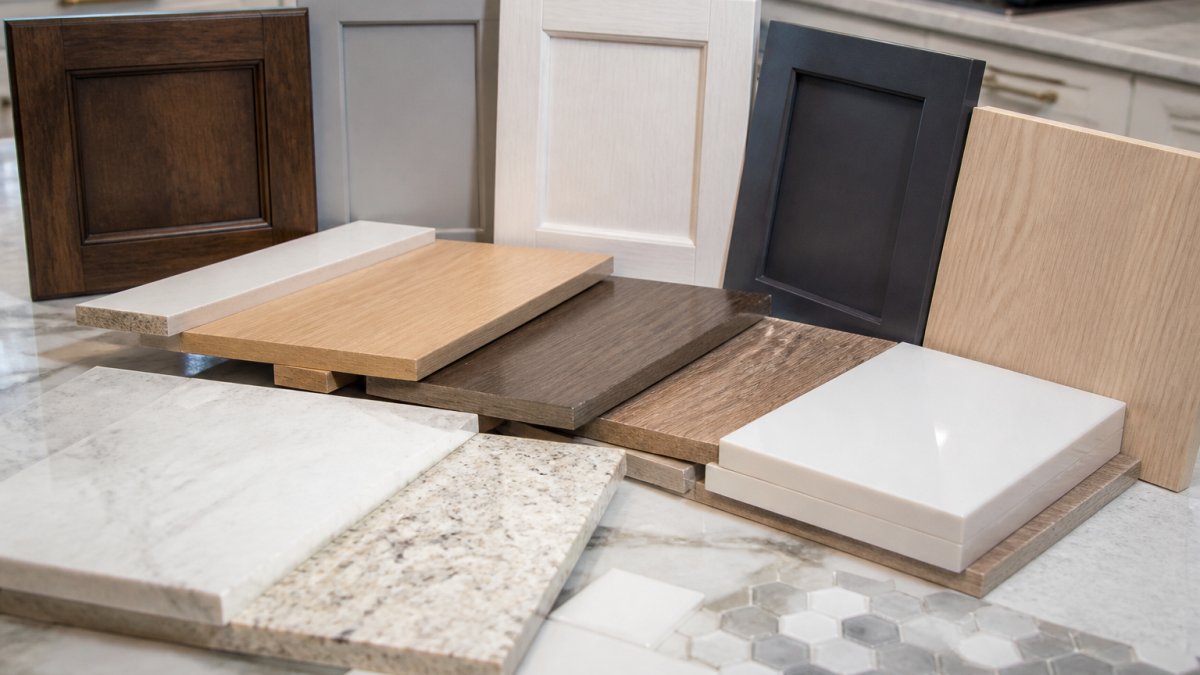
Solid wood means door frames and panels milled from a single species: oak, maple, cherry, birch, hickory, or walnut. It takes paint and stain beautifully and can be sanded and refinished years later. The trade-off is movement.
Plywood is engineered wood made from layered wood veneers glued crosswise.
MDF (medium-density fiberboard) is compressed wood fiber. It machines cleanly and holds paint without visible grain, making it a favorite for painted cabinet doors. It swells badly when water reaches the raw edges.
Particleboard is the budget composite. It is dense and stable when sealed, but a slow leak under a sink can turn it to mush. Wood veneer over MDF or particleboard gives the look of real grain at a lower cost.
Laminate, Thermofoil, and Metal Options
Laminate is a high-pressure laminate sheet bonded to a composite core. It resists scratches, stains, and moisture well, and it is the most budget-friendly way to get a uniform modern finish.
Thermofoil is a PVC film vacuum-pressed onto an MDF door. It delivers seamless, handle-free slab fronts at a low price. The weak point is heat: a door mounted too close to an oven can peel or delaminate at the edges.
Metal cabinets, usually stainless steel, offer the highest moisture and heat resistance of any option. They suit utility areas and modern designs, but they show fingerprints and cost more than most homeowners expect.
Solid Wood vs Plywood Cabinets: Which Holds Up Better?
Plywood cabinets generally hold up better in humid, spill-prone kitchens, while solid wood wins on refinishability and resale appeal. The reason comes down to construction: plywood's cross-layered veneers resist warping and swelling far better than a solid wood panel of the same thickness.
Solid wood still earns its place on doors, drawer fronts, and face frames, where its grain and refinishing value matter most. Many well-built cabinets combine the two: plywood boxes with solid wood doors.
Where solid wood falls short is in wide, flat panels near heat or moisture. A solid wood panel beside a dishwasher can cup over a few seasons. Plywood in the same spot stays flat.
Most Durable Kitchen Cabinet Materials for Busy Homes
The most durable kitchen cabinet materials for busy households are plywood boxes paired with laminate, thermofoil, or metal doors. These combinations handle daily scrubbing, splashes, and heavy use without the maintenance that painted wood demands. The key is to judge durability by component, not by a single material label, because the box, frame, door, and drawer box each face different stresses.
Durability by cabinet component
- Cabinet box: plywood or moisture-resistant composite for structural strength and moisture tolerance
- Face frame: solid wood for strength and refinishing
- Door and drawer front: laminate, thermofoil, or solid wood depending on budget and wear
- Drawer box: solid wood or plywood for load performance and joint strength
- High-wear zones: sink bases, dishwasher-adjacent cabinets, and drawer fronts benefit most from moisture-resistant and refinishable materials
Ranked by durability in high-traffic kitchens, with the component caveat in mind:
- Metal: highest heat and moisture resistance, moderate scratch resistance
- High-pressure laminate: strong scratch and stain resistance, low repairability
- Plywood with solid wood doors: strong structure, refinishable, needs humidity control
- Thermofoil: good surface durability, weak at heat-exposed edges
- Painted MDF: good looks, poor moisture tolerance at seams
- Particleboard: lowest durability in wet zones
Environment-based performance
Durability depends on where the cabinet sits as much as what it is made of. In humid or coastal kitchens, plywood boxes outperform particleboard and MDF because the cross-layered veneers resist swelling. Sealing every cut edge and using moisture-resistant board under sinks buys years of life.
Spills matter too. Laminate and metal wipe clean without damage. Painted MDF and particleboard need immediate drying, because water that reaches the core causes swelling that cannot be reversed. In dry rooms, painted MDF doors perform well and hold a clean finish, which is why they remain popular for upper cabinets away from water.
For a family kitchen with kids, laminate doors on plywood boxes offer the best balance of durability and cost. For a showpiece kitchen, solid wood doors on plywood boxes deliver both looks and structure.
Click and Make your "IN-STORE" appt today! →
Kitchen Cabinet Material Cost: What Drives the Price
Kitchen cabinet material cost is driven by four factors: the box material, the door material and finish, the hardware, and the installation complexity. Material choice alone rarely decides the final number, but it sets the floor. Most practitioners find that the box and door together account for the majority of the material line, with hardware and installation making up the rest.
A useful way to compare materials is by relative cost tier rather than a single number, because pricing varies by region, door count, and finish. In broad terms:
- Budget tier: particleboard boxes with laminate or thermofoil doors
- Mid tier: plywood boxes with MDF or laminate doors, or solid wood doors on plywood boxes
- Premium tier: plywood or solid wood boxes with solid wood doors and painted or stained finishes
- Specialty tier: metal cabinets and custom inset construction
Within each tier, the door style and finish move the price more than the box material. Flat slab doors cost less than raised-panel or inset doors because they use less material and fewer machining steps. Painted and stained finishes cost more than laminate or thermofoil because they require more labor and a controlled spray environment. Custom sizing raises the price of any material because non-standard dimensions increase waste and setup time.
Lifecycle cost, not just purchase price
The missed angle in most cost guides is lifecycle cost. A cheaper box material can cost more over time if it fails early. Particleboard and MDF swell when water reaches raw edges, and that damage usually means replacing the panel rather than repairing it.
A practical way to think about it: compare the initial material cost against the expected years of service and the cost of the most likely repair. A laminate door that cannot be sanded may need replacement after a deep scratch, while a solid wood door can be refinished.
- Box material: plywood costs more than particleboard or MDF up front but resists moisture better, reducing the risk of early panel replacement
- Door style: flat slab doors cost less than raised-panel or inset doors
- Finish: painted and stained finishes cost more than laminate or thermofoil
- Custom sizing: non-standard dimensions raise the price of any material
- Repairability: refinishable materials can defer replacement costs; non-refinishable materials may require panel replacement
Pricing depends on your layout, door count, and finish selections, so we quote each project individually rather than publish a rate card. The U.S. Environmental Protection Agency guidance on indoor air quality is also worth reviewing, because composite boards and finishes can affect indoor air, and our team can walk you through low-emission options.
Performance in Humid, Hot, and Spill-Prone Kitchens
Humidity is the quiet killer of kitchen cabinets. Composite boards swell at raw edges, thermofoil peels near heat sources, and solid wood panels move with seasonal moisture swings.
In humid climates, plywood boxes outperform particleboard and MDF because the cross-layered veneers resist swelling. Sealing every cut edge and using moisture-resistant board under sinks buys years of life. Near ovens and dishwashers, metal and laminate surfaces hold up better than painted wood or thermofoil.
Spills matter too. Laminate and metal wipe clean without damage. Painted MDF and particleboard need immediate drying, because water that reaches the core causes swelling that cannot be reversed.
Construction, Repairability, and Indoor Air Quality
Cabinet construction details decide how long a material actually lasts. The box, frame, and door can each be a different material, and the weakest one sets the lifespan.
- Box: plywood or moisture-resistant composite for durability
- Frame: solid wood for strength and refinishing
- Door: solid wood, MDF, laminate, or thermofoil based on budget and use
- Drawer boxes: solid wood or plywood for load performance
Repairability separates the materials sharply. Solid wood and plywood can be sanded and refinished. Laminate, thermofoil, and melamine usually need replacement panels. Metal can be cleaned and touched up but not refinished.
Indoor air quality is the angle most guides ignore. Composite boards and some finishes can emit volatile organic compounds, and the U.S.
Choosing cabinet materials is a balance of moisture, budget, and how long you plan to stay.
My Kitchen Design EXPO brings nearly 40 years of design expertise, 3D visualization before construction, and a one-stop shop for cabinetry and countertops so your project is planned correctly from day one.
Frequently Asked Questions
What is the best material for kitchen cabinets?
There is no single best cabinet material; the right choice depends on budget, moisture exposure, and finish goals. Plywood boxes with solid wood or MDF doors balance durability and cost for most kitchens. Solid wood suits visible, painted, or stained faces, while laminate and thermofoil handle humid, spill-prone rooms with less maintenance. Compare cabinet material options by how each performs in your specific kitchen rather than by reputation alone.
Which kitchen cabinet material is the most durable?
Solid wood and plywood tend to be the most durable kitchen cabinet materials because they resist warping and hold screws well. High-pressure laminate and metal also hold up under heavy use and moisture. Particleboard and MDF are less durable in wet areas because they swell when water reaches the core. For long-term durability, focus on plywood cabinet boxes and quality hardware, since hinges and drawer slides often fail before the material itself.
Is MDF or particleboard better for kitchen cabinets?
MDF is denser than particleboard and takes paint and routed profiles more cleanly, so it is the better choice for painted cabinet doors. Particleboard is cheaper and works for cabinet boxes in dry areas, but it swells faster when exposed to water. Neither is ideal under sinks or near dishwashers without sealed edges. Many cabinet material cost decisions come down to this trade-off between price and moisture tolerance.
Which cabinet materials hold up best to moisture?
Plywood, high-pressure laminate, thermofoil, PVC, and stainless steel hold up best to moisture. Solid wood resists water but can warp if the finish fails. Particleboard and MDF are the weakest in humid or spill-prone kitchens because their cores absorb water and swell. Sealed edges, tight joinery, and proper ventilation matter as much as the material itself, especially around sinks and dishwashers.