 blog
Is a Pot Filler Worth the Cost? An Honest Breakdown
Last Updated: November 12, 2026
Quick Summary
A pot filler is worth it if you often fill large, heavy pots and already have, or can reach, a cold-water line behind the cooktop. It saves you from carrying full pots across the kitchen, but it adds installation cost beyond the faucet itself.
- A pot filler fills large pots right where they sit on the burner.
- It needs a cold-water line routed inside the wall behind the range.
- Installation adds cost beyond the faucet itself, so compare detailed estimates.
- Skip it if you rarely fill large pots or cook on a stand-alone island.
- Adding one during a remodel is far cheaper than retrofitting it later.
Table of Contents
- What a Pot Filler Actually Does in Your Kitchen
- Pot Filler Pros and Cons Compared Side by Side
- Pot Filler Cost: An Itemized Breakdown
- Rough-In Requirements and Whether Your Kitchen Can Take One
- Do Pot Fillers Add Value to a House?
- Alternatives and Their Comparative Costs
- A Decision Guide Based on How You Cook and Plan to Remodel
- Scheduling a Kitchen Consultation to Price Your Pot Filler
- Frequently Asked Questions
What a Pot Filler Actually Does in Your Kitchen
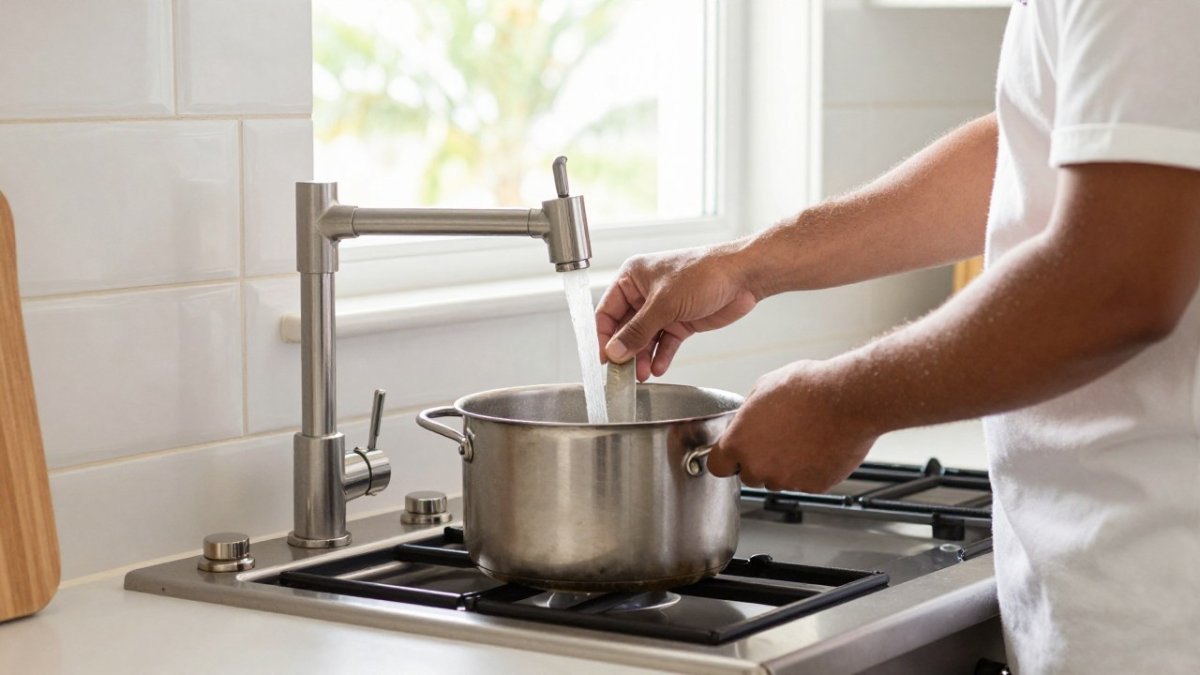
Is a pot filler worth the cost? For many American homeowners, the answer depends on how often they cook with large, heavy pots. A pot filler is a faucet mounted on the wall above the cooktop. It fills pots right where they sit on the burner, so you never have to haul a full stockpot across the kitchen. At My Kitchen Design EXPO, we help Central Florida homeowners decide whether this kind of fixture fits their kitchen and their cooking habits.
Most pot fillers use a folding or swing arm. You pull the arm over the range, fill the pot, and swing the arm back out of the way.
The main job of a pot filler is convenience. Soup pots, pasta pots and large braising pans can weigh a lot once they hold water. Filling them at the stove saves you from carrying that weight across the room and spilling water on the floor on the way.
- Reach: A folding arm can cover the front burners and most of the cooktop.
- Water source: It connects to a cold-water supply line inside the wall.
- Control: Most designs use a standard lever or handle, like a regular faucet.
Watch out: A pot filler needs a cold-water line routed inside the wall behind the range. Many kitchens do not have one in that spot, so check before you shop.
Pot Filler Pros and Cons Compared Side by Side
A pot filler makes a lot of sense for some kitchens and very little sense for others. Use the list below to weigh the trade-offs against your own cooking habits.
Pros:
- Fills large pots at the stove without carrying them
- Saves time for cooks who make big batches of pasta, stock or soup
- Reduces the risk of spills and back strain from heavy pots
- Adds a finished, high-end look to a remodeled kitchen
Cons:
- Requires a cold-water line in the right wall location
- Adds installation cost beyond the faucet itself
- Only useful if you fill large pots often
- Creates a splash zone that needs regular wiping
One common mistake is buying a pot filler for a kitchen where the cooktop sits on a stand-alone island. Without a wall behind the range, installation becomes far more complicated and costly.
The trade-offs come down to a few practical points, summarised below.
| Factor | Pro | Con |
|---|---|---|
| Carrying heavy pots | Fills pots at the stove | Only useful for frequent large-pot cooks |
| Water supply | Simple fixture | Needs a cold-water line in the right wall |
| Installation | Adds a high-end look | Adds cost beyond the faucet itself |
| Maintenance | Reduces spills on the floor | Splash zone needs regular wiping |
Pot Filler Cost: An Itemized Breakdown
Pricing depends on several factors, including the fixture, plumbing work, wall access and permits. My Kitchen Design EXPO does not publish standard pricing for pot fillers, so visit the website or request a quote for current prices. For the wider context, see the kitchen remodel budget guide.
Ask for a detailed estimate from any contractor so you can compare bids on equal terms. Our custom cabinetry installation cost guide explains what installation labor typically runs for added fixtures.
Rough-In Requirements and Whether Your Kitchen Can Take One
A pot filler is a simple fixture with a demanding rough-in. Before you shop, confirm that your kitchen can actually support one. The requirements fall into four areas: water supply, wall access, structural and electrical conflicts, and clearance for the arm.
A pot filler generally needs a cold-water line routed to the wall behind the cooktop. Whether an existing line is nearby depends on the layout of your kitchen.
Wall access. How the wall is built affects the installation. Access and repair needs vary by wall type.
Retrofit versus remodel. Adding a pot filler during a remodel can be simpler than a retrofit into a finished kitchen, since walls may already be open.
Ask yourself these questions:
- Is there a wall behind the range or cooktop?
- Is there an existing cold-water line nearby?
- Does the layout leave room for the fixture?
A kitchen remodel can be a good time to plan for a pot filler, because walls may already be open. Our guide to how long a full kitchen remodel takes helps you schedule the plumbing work. Our team at My Kitchen Design EXPO can review your layout and discuss whether a pot filler fits.
Do Pot Fillers Add Value to a House?
A pot filler can help a kitchen feel more complete. Buyers tend to respond to the overall kitchen layout, finishes and function more than any single fixture.
Be careful about treating a pot filler as a return on investment. The better question is whether the feature fits your kitchen and how long you plan to stay in the home.
Watch out: Do not add a pot filler only to improve resale. If you rarely fill large pots, the feature may sit unused.
Alternatives and Their Comparative Costs
If a pot filler does not fit your kitchen or budget, several alternatives can reduce the carrying. Each one has its own trade-offs.
A Decision Guide Based on How You Cook and Plan to Remodel
Use the questions below to decide whether a pot filler is worth it for your kitchen. For a step-by-step framework, read how to plan a kitchen renovation.
- How often do you cook with large pots? If you fill them weekly, a pot filler saves real effort. If you rarely do, skip it.
- Do you have a cold-water line near the cooktop? If not, the install cost rises.
- Are you already remodeling? Adding a pot filler during a remodel is far cheaper than retrofitting one later.
- Is the wall behind the range accessible? Open walls and existing plumbing lower the cost.
- How long will you live in the home? A longer stay gives you more years to enjoy the convenience.
If you answered yes to most of these questions, a pot filler is likely worth considering. If not, a standard faucet and lighter cookware may serve you better.
Scheduling a Kitchen Consultation to Price Your Pot Filler
The best way to find out whether a pot filler fits your kitchen is a consultation. At My Kitchen Design EXPO, we bring decades of design experience to each project. Our one-stop shop handles design and construction, so you do not need to coordinate separate contractors for the faucet, plumbing and wall work.
Our 3D virtual design service lets you see your kitchen design in 3D before work begins. We also provide turn-key construction services.
Click and make your "IN-STORE" appt today. Visit My Kitchen Design EXPO to schedule your consultation and request a quote for your pot filler project. Learn how to get custom kitchen cabinetry quotes before you meet with us.
Frequently Asked Questions
What is the downside of a pot filler?
The main downsides are installation cost, the need for a cold water line and wall access behind the cooktop, and the fact that the fixture sees little use in kitchens where most pots are filled at the sink. Plumbing mistakes can cause leaks inside the wall, so installation should be handled by a licensed plumber. Weigh these costs against how often you fill large pots at the stove before committing.
Do pot fillers add value to a house?
A pot filler can appeal to buyers who cook often, but it is rarely a major driver of resale value on its own. Its impact depends on the overall kitchen design, finish quality and the price point of the home. Think of it as a finishing feature within a complete kitchen remodel rather than a standalone upgrade. Discuss expected resale impact with a local real estate professional, and plan the fixture around how you will use the kitchen.
How much does it cost to install a pot filler?
Pricing depends on fixture quality, whether the cold water line already sits near the cooktop, the wall construction, and the labor involved. My Kitchen Design EXPO does not publish a standard price for pot fillers, so pricing depends on your specific project. Visit mkdexpo.com or schedule an in-store appointment for a quote based on your kitchen layout.
Is a pot filler easier to install during a kitchen remodel?
Yes. When walls are open and cabinets are being reinstalled, a plumber can run the cold water supply to the chosen location more easily. Retrofitting an existing kitchen means opening finished walls, which adds labor and repair work. Planning the rough-in before drywall and cabinet installation can reduce the risk of water damage from poor connections.