 blog
Are There Better Cabinet Stores Than Cabinets To Go?
Last Updated: October 26, 2026
Quick Summary
The best cabinetstogo alternatives depend on your layout, timeline, and how much work you want to handle. RTA cabinets suit standard layouts on tight budgets, assembled store-bought lines remove assembly time, and turn-key providers manage the whole sequence. Compare box construction, hardware, delivery, and assembly state before you buy.
- Plywood boxes generally resist moisture better than particleboard in kitchens with heavy sink use.
- Many retailers will not accept returns on made-to-order or assembled cabinets, so confirm the policy in writing.
- A full kitchen of RTA cabinets typically takes a homeowner a weekend or more to assemble.
- Normalize every quote to the same scope, since a quote omitting delivery or hardware is not cheaper.
- Choose turn-key if your project touches plumbing or electrical or your layout is non-standard.
Table of Contents
- What to Compare Before You Buy Cabinetstogo Alternatives
- IKEA Kitchen Cabinets vs. Cabinets To Go
- Best RTA Kitchen Cabinets as a Lower-Cost Option
- Kitchen Cabinet Installation Services: DIY vs. Turn-Key
- Setting a Realistic Kitchen Remodel Cabinet Budget
- Which Cabinetstogo Alternative Fits Your Project?
- Book an In-Store Design Appointment
- Frequently Asked Questions
What to Compare Before You Buy Cabinetstogo Alternatives
Cabinetstogo alternatives matter most when you compare what sits behind the doors, not just the showroom display. At My Kitchen Design EXPO, we have spent years walking homeowners through this exact decision.
The information below comes from our design team's experience guiding kitchen projects. What follows is practical guidance built from real project conversations.
Start with four comparison points before you visit any store:
- Cabinet box construction: plywood versus particleboard, and how the joints are built
- Door and drawer hardware: soft-close hinges, drawer glides, and whether they are included or extra
- Delivery and lead time: in-stock versus made-to-order, and who handles damage claims
- Assembly state: ready-to-assemble, pre-assembled, or fully custom
A common mistake is treating all three assembly states as interchangeable. They are not. Assembly state affects your labor cost, your timeline, and how much control you have over sizing.
Construction, Materials, and Door Styles
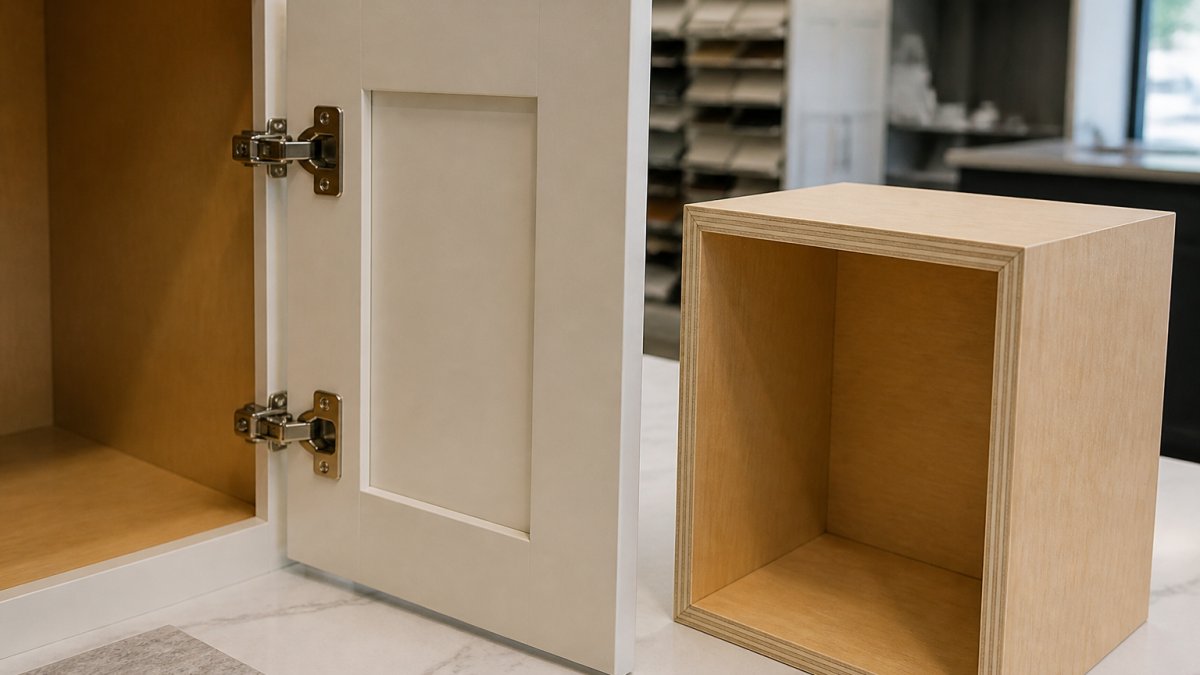
Construction quality is where most budget cabinets hide their compromises.
Plywood boxes generally resist moisture better than particleboard, which matters in kitchens with heavy sink use.
Finish is the other decision. A painted finish gives you a uniform color and covers the grain, while a stained finish shows the wood character and hides minor wear better over time.
If you are still weighing materials, our guide to the best kitchen cabinet material options breaks down the trade-offs in more detail. Readers who want a deeper comparison of stock versus made-to-order construction can review custom versus stock kitchen cabinets before committing.
Warranty, Returns, and Replacement Parts
Warranty terms are the least-compared and most-regretted part of a cabinet purchase. Most cabinet warranties cover manufacturing defects, not installation damage or normal wear, and the fine print often limits coverage to replacement parts rather than labor.
Ask three questions before you buy:
- What exactly does the warranty cover, and for how long?
- Who pays shipping on a replacement door or drawer front?
- What is the return window, and does it apply to assembled or made-to-order units?
Watch out: many retailers will not accept returns on made-to-order or assembled cabinets, so a single mismeasured cabinet can become a sunk cost. Confirm the return policy in writing before you order, especially for custom sizing.
Replacement parts availability matters just as much. A cabinet line discontinued two years after your purchase leaves you matching doors from a salvage source.
IKEA Kitchen Cabinets vs. Cabinets To Go
IKEA kitchen cabinets and Cabinets To Go sit at opposite ends of the assembly and service spectrum.
The trade-off is straightforward.
Neither model includes installation unless you buy it separately, and neither is a custom shop.
For a side-by-side look at how another retailer stacks up on the same criteria, our Cabinets To Go comparison benchmarks the two directly.
Where IKEA wins: budget-conscious buyers with standard layouts and the time to assemble.
Where a store-bought assembled line wins: buyers who want the boxes delivered ready to hang and prefer a design consult.
Best RTA Kitchen Cabinets as a Lower-Cost Option
Ready-to-assemble cabinets are the most cost-effective path when you can supply the labor.
The best RTA kitchen cabinets share a few traits: plywood or high-density box construction, pre-drilled assembly holes, and hardware included rather than sold as an upgrade.
Assembly time is the hidden cost. A full kitchen of RTA cabinets typically takes a homeowner a weekend or more to assemble, depending on cabinet count and experience.
RTA also gives you a real advantage on customization within standard sizes.
A common mistake is buying the cheapest RTA line and then upgrading hinges and glides separately. Price the hardware in from the start, or the savings shrink fast.
Kitchen Cabinet Installation Services: DIY vs. Turn-Key
Kitchen cabinet installation services split into two paths: you hang the cabinets yourself, or you hand the project to a turn-key provider who manages the whole job. The useful comparison is not which path sounds better. It is what each path includes, what it costs beyond the cabinet price, and which risks land on you.
Click and Make your "IN-STORE" appt today! →
What each path actually includes
DIY installation means you measure, plan the layout, assemble if the cabinets are ready-to-assemble, set the base and wall runs level and plumb, shim and fasten, install filler strips and trim, hang doors and drawers, and adjust hardware.
Turn-key installation bundles cabinet delivery, layout, installation, and often countertop templating and installation, plumbing reconnects, and electrical work for under-cabinet lighting or outlets.
A middle path is common and often the best value: buy the cabinets from a retailer and hire an independent installer for the hang, then manage countertops and trades yourself. It costs less than full turn-key but shifts coordination back to you.
The costs beyond the cabinet price
Cabinet price is only one line in the installed cost. Build the full picture before you compare retailers, because a lower cabinet price can lose to a higher one once labor and extras are counted.
- Cabinet cost: the line price for boxes, doors, and drawer fronts
- Hardware: soft-close hinges and drawer glides, sometimes included and sometimes an upgrade
- Assembly labor: zero for pre-assembled, a weekend or more of your time for ready-to-assemble
- Delivery: flat-rate, per-cabinet, or free above a threshold; confirm whether it is curbside or inside delivery
- Installation labor: varies by region, cabinet count, and layout complexity; get at least two written quotes
- Trim and filler: filler strips, crown, toe kick, and end panels are often priced separately
- Countertop templating and install: sequenced after cabinets are set
- Plumbing and electrical: reconnects and any new circuits or lighting
- Disposal: hauling away old cabinets and packaging
Normalize every quote to the same scope before comparing totals. Ask each retailer and installer to quote the same cabinet count, the same hardware, inside delivery, installation, and disposal. A quote that omits delivery or hardware is not cheaper; it is incomplete.
The risks each path shifts onto you
DIY keeps labor cost down but concentrates risk. A single out-of-level wall run throws off the countertop and the backsplash, and correcting it later costs more than the labor you saved.
Turn-key shifts coordination risk to the provider, but you still own the scope.
Hiring the cheapest independent installer often shifts risk onto you in the same way.
(https://blog.mkdexpo.com/is-turn-key-kitchen-renovation-worth-it) walks through the trade-offs.Setting a Realistic Kitchen Remodel Cabinet Budget
A realistic cabinet budget starts with the full remodel, not the cabinet line alone. Cabinets are usually the largest single line item, but countertops, installation labor, plumbing, electrical, and permits all draw from the same pool.
Build your budget in this order:
- Set the total remodel figure you can spend without financing stress
- Reserve a contingency for surprises behind the walls
- Allocate the cabinet share based on whether you choose RTA, assembled, or custom
- Price hardware, delivery, and installation as separate lines
For full remodel cost context so you can allocate spending realistically, see our kitchen remodel cost budget guide.
A common mistake is comparing cabinet prices across retailers without comparing what is included. One quote may include hardware and delivery; another may not. Normalize every quote to the same scope before you compare totals.
Which Cabinetstogo Alternative Fits Your Project?
The right Cabinetstogo alternative depends on your layout, your timeline, and how much of the work you want to handle. There is no single best store, only the best fit for your project.
Use this framework to decide:
| Your situation | Best-fit option | Why it fits |
|---|---|---|
| Standard layout, tight budget, willing to assemble | RTA cabinets | Lowest cost, flexible sizing |
| Standard layout, no assembly time | Assembled store-bought line | Delivered ready to hang |
| Odd layout or non-standard walls | Custom or made-to-order | Built to your dimensions |
| No time to coordinate trades | Turn-key provider | One team manages the sequence |
| Wants to see the design first | 3D design consultation | Approve before construction |
Our honest view: if your kitchen is small, oddly shaped, or part of a larger renovation, a design-led turn-key approach can help avoid sizing errors and trade coordination mistakes. If your layout is standard and your budget is tight, RTA can be a smart play.
Best for: homeowners with non-standard layouts and full-renovation scope. Skip if: you have a standard layout and want to assemble and install the cabinets yourself.
Book an In-Store Design Appointment
The fastest way to settle the Cabinetstogo alternatives question is to see your own kitchen drawn to scale.
Our one-stop shop model means design, cabinetry, quartz or granite countertops, and turn-key construction sit with one team. You are not coordinating a cabinet retailer, a countertop fabricator, and an installer separately.
Customers often ask whether 3D visualization is accurate.
If you are concerned about having multiple trades in your home, ask us how the turn-key sequence works at your appointment. We will walk you through who handles what and when.
Frequently Asked Questions
Are cabinets from Cabinets To Go good quality?
Cabinets To Go sells a mix of ready-to-assemble and pre-assembled cabinets, and quality varies by line. Check the cabinet box material, drawer construction, and hinge hardware before you commit. Ask whether the boxes are plywood or particleboard, whether drawers are dovetailed, and what the warranty covers. Reviews of any cabinet retailer should be read alongside the specific product line, because a single brand can sell both entry-level and sturdier options.
What are the best Cabinetstogo alternatives for a full kitchen renovation?
The right alternative depends on your budget and how much work you want to manage. IKEA suits flat-pack buyers who will assemble and install themselves. RTA cabinet sellers cut cost if you can handle assembly. A local design-and-build shop fits homeowners who want made-to-order cabinets, countertops, and installation handled by one team. Compare total installed cost, lead time, and warranty terms, not just the sticker price per cabinet box.
Is $30,000 enough for a kitchen remodel?
It can be, depending on kitchen size, cabinet line, and whether you change the layout. Cabinets and countertops typically take the largest share of a kitchen remodel cabinet budget, with labor, plumbing, and electrical adding more. A mid-range project with stock or RTA cabinets and a simple layout leaves more room in that figure than a full custom build with moved walls. Get an itemized quote so you can see where the money goes before work starts.
How much should I budget for kitchen cabinets?
Cabinets are usually the single biggest line item in a kitchen renovation, so set the cabinet budget before you fall in love with a door style. Stock and RTA options cost less per box than made-to-order or custom cabinets, but assembly and installation labor add back some of the savings. Ask each supplier for a written quote covering cabinet boxes, fronts, hardware, delivery, and installation so you can compare overall value rather than price per unit.
Your kitchen deserves a plan you can see before you spend. Get started with My Kitchen Design EXPO and book an in-store design appointment to review your layout, compare cabinetry options, and see your kitchen in 3D before construction begins.