 blog
How to Compare Quality Design and Remodel vs DLCabinetry
Last Updated: October 29, 2026
Quick Summary
Comparing quality design and remodel vs dlcabinetry comes down to whether you are buying a finished kitchen or a box of cabinets. A cabinet supplier sells product with a delivery date, while a design-build remodeler sells an outcome with measurements, design, demolition, installation, and one point of accountability. Compare complete scopes, not a cabinet line item against a full remodel quote.
- Score both providers on the same weighted scorecard, rating each criterion from 1 to 5.
- Ask both providers the same five questions before comparing a single price.
- Stock cabinets suit standard layouts, semi-custom adjust width and height, and custom solve odd shapes.
- MDF swells when water sits on an unprotected edge, so sealed edges matter.
- Ask the insurer to send the certificate of insurance directly, not a photocopy.
Table of Contents
- Quality Design and Remodel vs DLCabinetry: What Each One Actually Sells
- How to Choose a Home Renovation Company When Cabinets Are the Core Decision
- Cabinet Quality Tiers: Good, Better, and Best in Real Projects
- Cabinet Materials and Construction: MDF Panels, Paint-Grade, and Wood Species
- Average Cost of Kitchen Cabinet Installation and What Drives the Number
- Kitchen Remodeling Contractor Evaluation: Warranty, Licensing, Insurance, and Written Scope
- Book an In-Store Appointment to Compare Cabinetry and Design Options
- Frequently Asked Questions
Quality Design and Remodel vs DLCabinetry: What Each One Actually Sells
Comparing quality design and remodel vs dlcabinetry starts with one question: are you buying a finished kitchen or a box of cabinets? That distinction matters more than any showroom finish.
A cabinet supplier sells product. For a direct head-to-head, see this Cabinets To Go vs DLCabinetry comparison. A design-build remodeler sells an outcome. One gives you cabinet boxes and a delivery date; the other gives you measurements, design, fabrication, demolition, installation, and a single point of accountability when something goes wrong.
Below, we break down how to compare both models, what drives installation costs, and how to score bids so the cheapest number does not win by default. For a deeper look, see this guide to Quality Design and Remodel alternatives.
How to Choose a Home Renovation Company When Cabinets Are the Core Decision
Choosing a home renovation company starts with deciding how much of the project you want to manage yourself. If you can measure your own space, coordinate trades, and absorb schedule slips, a cabinet-only supplier can work. If you want one contract and one phone number, you need a turn-key provider. The useful next step is to compare the two named options on the same criteria rather than on brand impression.
A neutral side-by-side framework
Use this scorecard to compare Quality Design and Remodel with DLCabinetry on like-for-like terms. Score each row from 1 (weak) to 5 (strong), and weight the rows that matter most to your project. Do not let a single low price override a weak score on scope or accountability.
| Criterion | What to verify | Why it matters |
|---|---|---|
| Service model | Does the provider sell cabinets only, or design, fabrication, demolition, and installation under one contract? | A cabinet-only model shifts coordination risk to you. |
| Measurement and design | Who measures, is the measurement guaranteed, and is 3D visualization included? | Measurement errors are the most common source of change orders. |
| Written scope | Are demolition, disposal, electrical, plumbing, permits, and finish carpentry listed as included or excluded? | Exclusions are where budgets break. |
| Licensing and insurance | Can the provider show state licensing for the trades and a current certificate of insurance from the insurer? | Unlicensed or uninsured work leaves you exposed. |
| Warranty | Are product and workmanship warranties in writing, and what is the service window? | Warranty terms separate a finished job from a finished relationship. |
| Schedule | What are the lead times for cabinets, the installation window, and the punch-list process? | Schedule slips are the most common complaint in remodeling. |
| Communication | Is there one point of contact, and how are change orders documented? | Clear communication prevents disputes. |
| Portfolio fit | Are there recent completed projects similar in size and layout to yours? | Past work is the best predictor of future fit. |
The five questions to ask both providers
Ask every company the same five questions before you compare a single price:
- Who measures the space, and is that measurement guaranteed?
- Does the quote include demolition, disposal, electrical, and plumbing?
- Who pulls permits, and who is licensed to do the work?
- What is the written scope, and what is explicitly excluded?
- What happens if a cabinet arrives damaged or a wall is out of square?
A common mistake is comparing a cabinet line item against a full remodel quote. Those are not the same product. Compare complete scopes or you are comparing nothing. If a provider cannot answer a row on the scorecard in writing, treat that as a weak score.
What each model actually delivers
A cabinet supplier delivers product: boxes, doors, hardware, and a delivery date. A design-build remodeler delivers an outcome: measurements, design, fabrication, demolition, installation, and a single point of accountability when something goes wrong. Neither model is inherently better; the right choice depends on how much coordination you want to own and how much risk you can absorb.
Cabinet Quality Tiers: Good, Better, and Best in Real Projects
Cabinet quality tiers separate construction methods, not marketing labels. The useful framework is simple: good covers stock cabinets with basic joinery, better covers semi-custom lines with upgraded hardware and finishes, and best covers custom cabinetry built to your dimensions with premium materials.
In practice, the tier you need depends on the room:
- Stock cabinets suit standard layouts and tight budgets, but they limit sizes and configurations.
- Semi-custom cabinets adjust width and height, which matters in older homes where walls are rarely square.
- Custom cabinets solve odd shapes, small kitchens, and full-height designs that stock lines cannot fill.
Here is how most projects sort out:
| Tier | Construction | Best For | Main Trade-off |
|---|---|---|---|
| Good | Stock boxes, standard sizes | Rental units, quick refreshes | Limited sizing, visible filler strips |
| Better | Semi-custom, upgraded hardware | Most family kitchens | Longer lead times |
| Best | Custom build, premium materials | Odd layouts, high-end finishes | Highest cost, longest schedule |
Cabinet Materials and Construction: MDF Panels, Paint-Grade, and Wood Species
Cabinet materials decide how the doors look, how they wear, and how they handle moisture. For the full picture, read this guide to kitchen cabinet material options. The three you will hear about most are MDF panels, paint-grade stock, and solid wood species.
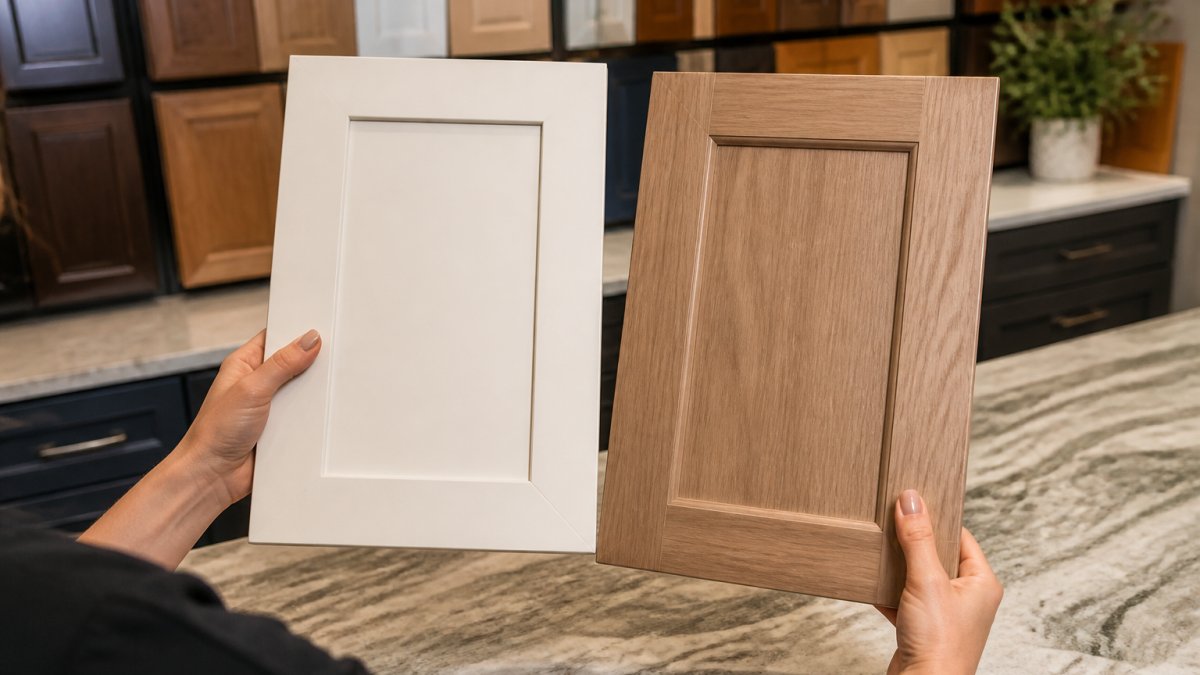
MDF panels are engineered wood with a smooth, uniform surface.
Watch out: MDF swells when water sits on an unprotected edge. In a kitchen with a leaking dishwasher or a sink cabinet that sees splashes, sealed edges and proper installation matter as much as the material itself.
Click and Make your "IN-STORE" appt today! →
Average Cost of Kitchen Cabinet Installation and What Drives the Number
There is no single average cost of kitchen cabinet installation, because the number is built from scope, not from a per-box rate. For a detailed breakdown, see this custom kitchen cabinetry installation cost guide. Two kitchens with identical cabinet counts can land far apart once you add demolition, electrical relocation, plumbing, countertops, and finish carpentry.
The factors that move the number most:
- Cabinet count, size, and tier
- Layout changes that require moving plumbing or electrical
- Wall condition, out-of-square openings, and soffit removal
- Countertop material and fabrication
- Appliance integration and panel-ready fronts
- Permit requirements and inspection scheduling
This is where cabinet-only quotes mislead. A low cabinet price often excludes installation, disposal, and finish work, so the total climbs after signing. Ask for an itemized, like-for-like quote that lists labor, materials, and exclusions separately.
Kitchen Remodeling Contractor Evaluation: Warranty, Licensing, Insurance, and Written Scope
Kitchen remodeling contractor evaluation comes down to paperwork, not personality. A friendly salesperson with a beautiful showroom can still leave you exposed if the contract is thin. A useful approach is to treat warranty, licensing, insurance, and written scope as a risk-allocation exercise: for each item, decide who owns the risk if something goes wrong, and confirm that the contract assigns it explicitly.
Who owns the risk?
| Risk | Cabinet-only model | Turn-key remodel model | What to confirm in writing |
|---|---|---|---|
| Measurement error | Often the homeowner | The remodeler | Who measures, and whether the measurement is guaranteed |
| Damaged or missing cabinets | Usually resolved by the supplier | The remodeler coordinates replacement | Replacement lead time and who pays for delays |
| Out-of-square walls | Homeowner coordinates a carpenter | The remodeler | Whether wall correction is in scope or a change order |
| Permit and inspection | Homeowner or separate contractor | The remodeler | Who pulls permits and who is licensed for each trade |
| Workmanship defects | Split between installer and supplier | The remodeler | Warranty length and service window for labor |
| Change orders | Homeowner approves each trade separately | One documented process | How changes are priced and approved |
The written-scope checklist
Run this checklist before you sign, and ask both providers to return it completed:
- Written scope listing every included and excluded item
- Proof of state licensing for the trades performing the work
- Current certificate of insurance, including general liability, sent directly from the insurer
- Warranty terms in writing, covering both product and workmanship
- Payment schedule tied to milestones, not to signing
- Project schedule with start and completion expectations
- References from recent projects similar in size to yours
- Change-order process documented in the contract
Licensing and insurance: verify, do not assume
The FTC guidance on home improvement contracts is worth reading before you sign anything, particularly on cancellation rights and written contract requirements. For licensing and insurance verification, your state's contractor licensing board is the authoritative source, and a certificate of insurance should come directly from the insurer, not a photocopy from the contractor. A low bid may exclude permit fees or insurance certificates; confirm both are present before comparing totals.
Turn the checklist into a bid score
Assign each checklist item a weight based on your risk tolerance. A homeowner planning to stay for decades should weight warranty and workmanship heavily; a homeowner planning to sell soon may weight schedule and price. Score each provider on the same weighted checklist, then compare the totals alongside the itemized quote. A written scope is your only real protection. If it is not on paper, it is not in the project.
Book an In-Store Appointment to Compare Cabinetry and Design Options
Comparing options works best when you can see them in one place. Photos hide construction details, and spec sheets do not show you how a finish reads under your own lighting.
An in-store visit lets you open drawers, check joinery, compare door profiles, and see how a painted finish differs from a stained wood species. It also lets you test the design process itself.
When you are ready to compare options, book an in-store appointment and bring your measurements, inspiration photos, and questions.
The hardest part of this decision is not picking a cabinet door. It is choosing who owns the outcome when the wall is out of square and the countertop template is wrong.
Frequently Asked Questions
What should I look for when comparing kitchen remodeling companies?
Start with the scope of work each company actually performs. A cabinet supplier sells cabinet boxes; a design-build firm manages demolition, plumbing, electrical, countertops, and installation under one contract. Ask for a written, itemized scope, a project schedule, and proof of licensing and insurance. Then compare bids on identical cabinet lines, finishes, and hardware so the price difference reflects service and workmanship, not a different specification.
Is it better to hire a design-build firm or a cabinet specialist?
A cabinet specialist works well when your layout stays the same and you only need new doors or boxes. A design-build firm fits projects that involve moving walls, relocating plumbing, or coordinating several trades. The trade-off is control versus coordination. With a specialist, you manage the other contractors yourself. With a design-build firm, one team owns the schedule and the finished result, which matters most in full kitchen remodels.
How do I verify the workmanship quality of a renovation contractor?
Ask to see two or three completed projects from the past year that match your scope, and request references you can call. Look at door alignment, drawer glide smoothness, caulk lines, and how the cabinets meet the ceiling and floor. Confirm the contractor carries licensing and insurance, and read the warranty in writing. A showroom visit also lets you open and close cabinet doors and inspect finishes before you commit.
How does 3D virtual modeling impact the renovation process?
3D modeling lets you see cabinet layout, door style, finish, and countertop choices before anything is ordered. It reduces the chance of approving a design on paper and disliking it in place. The model also helps confirm measurements and cabinet sizing, which lowers change orders during installation. Treat the 3D walkthrough as a planning tool, then verify final selections against physical samples in the showroom.