 Comparison
Is Quartz Worth It for Bathroom Countertops?
Last Updated: October 30, 2026
Quick Summary
Yes, quartz bathroom countertops are worth it for most households. They are non-porous, resist water and most stains, need little maintenance, and hold up well to daily use. They are not heat-proof or fully chemical-proof, so hot styling tools and harsh solvents need to be kept off the surface.
- Quartz is non-porous, so water tends to bead on the surface rather than soak in.
- Blot hair dye and cosmetic spills right away rather than wiping them.
- Keep a heat-resistant mat or trivet under hot styling tools to prevent permanent resin damage.
- Avoid bleach, abrasive scrubbers, and solvents such as nail polish remover.
- Quartz's upfront cost is higher, but its low maintenance can offset that over time.
Table of Contents
- What Quartz Does Well in a Bathroom
- Quartz Bathroom Countertop Pros and Cons
- Stain, Heat, and Chemical Limits You Should Know
- Quartz vs Granite Bathroom Countertops
- Quartz vs Marble Bathroom Vanity Tops
- What a Quartz Vanity Top Costs Over Its Lifetime
- How to Clean Quartz Bathroom Countertops
- Booking a Bathroom Consultation to Compare Your Options
- Frequently Asked Questions
Quartz bathroom countertops have become the default choice for many vanity tops, but they are not automatically the right one. At My Kitchen Design EXPO, we help Central Florida homeowners weigh material options against real daily use.
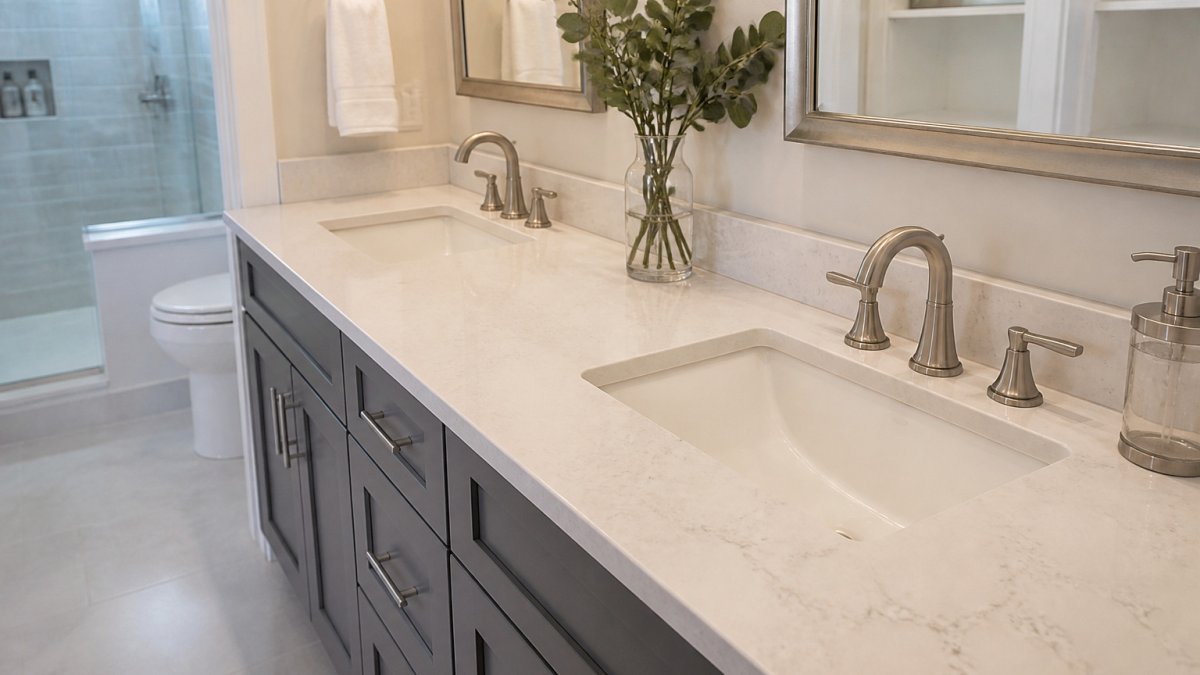
Quartz countertops are an engineered stone, typically made from ground natural quartz bound together with resin. That makes them denser and less porous than many natural stones, which is a major reason they are popular in bathrooms.
What Quartz Does Well in a Bathroom
Quartz works well in bathrooms because it resists the two things bathrooms throw at a surface most often: moisture and everyday wear. Its engineered structure gives it a uniform appearance and consistent performance across the full slab, which matters on a vanity top that gets used every morning.
Moisture and Water Resistance
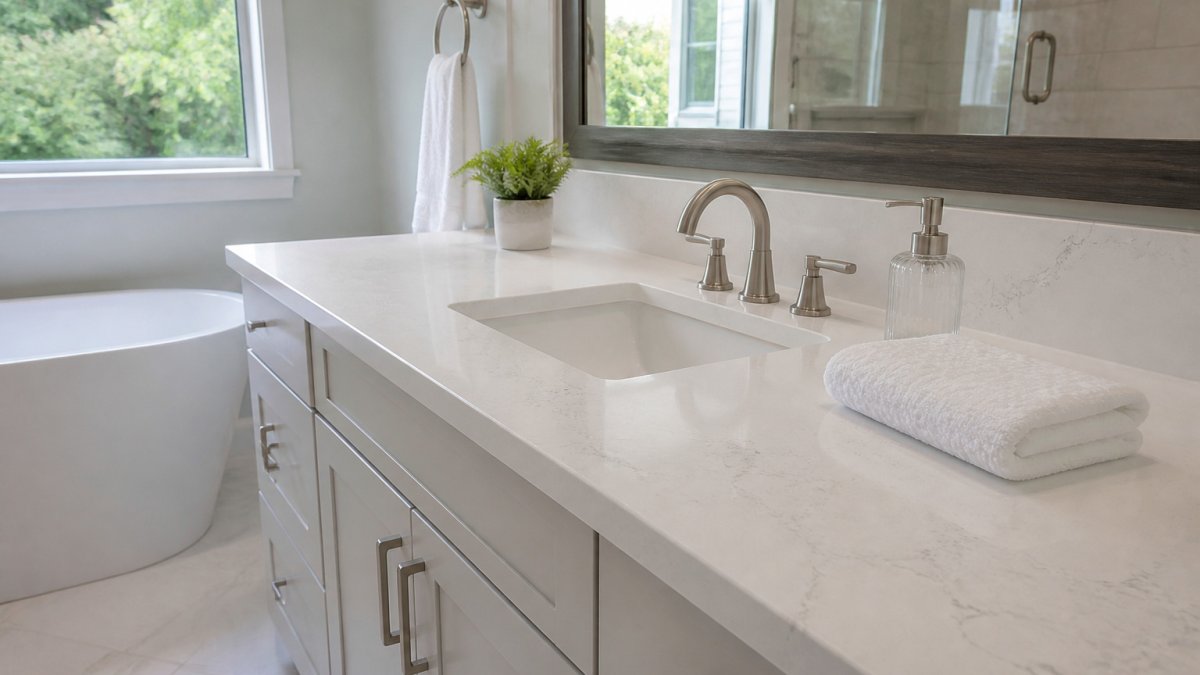
Bathrooms are humid, and vanity tops sit in the middle of that moisture. Quartz is largely non-porous, so water tends to bead on the surface rather than soaking in. That lowers the risk of water staining and of the bacteria buildup that can occur in porous materials.
Durability Against Daily Wear
A vanity top sees toothpaste, cosmetics, hair products and the occasional dropped razor. Quartz is hard and scratch-resistant, so it holds up to this routine use. It can still chip if something heavy lands on an edge, so it is worth handling bathroom fixtures and tools with the same care you would give any countertop.
Quartz Bathroom Countertop Pros and Cons
Quartz is a strong choice, but the trade-offs should be clear before you commit.
Pros:
- Non-porous surface that resists water and most stains
- Low maintenance with simple cleaning
- Consistent color and pattern across slabs
- Wide range of colors and finishes, including matte and glossy options
- Durable under normal daily use
Cons:
- Higher upfront cost than laminate or basic solid-surface options
- Can chip or crack under heavy impact
- Not fully heat-proof, so hot styling tools need a trivet or mat
- Resin content means it is not ideal for extreme heat exposure
Stain, Heat, and Chemical Limits You Should Know
Quartz is stain-resistant, not stain-proof, and the bathroom is full of products that test that distinction. The resin binder that makes quartz non-porous is also the part of the material most vulnerable to heat and harsh chemistry, so understanding the mechanism helps you avoid the marks that are hardest to remove.
Stains: What Actually Causes Them
Because quartz is non-porous, most stains sit on the surface rather than soaking in, which is why prompt cleanup usually works. The exceptions are products with strong pigments or dyes that are left in contact long enough to bond with the surface:
- Hair dye and color treatments, the most common bathroom culprit. A single drip wiped up quickly is usually fine; a spill that sits overnight can leave a shadow.
- Cosmetics, liquid foundation, mascara, and tinted moisturizer can leave marks if they dry on the surface.
- Toothpaste with colored stripes or whitening agents, usually harmless when rinsed, but dried residue in a seam can discolor.
- Nail polish and remover, remover is a solvent and belongs on the chemical list below, not just the stain list.
Cleanup protocol: blot, do not wipe, so you do not spread the pigment. Use a soft cloth with mild dish soap and warm water, then rinse and dry. For a stubborn mark, a soft sponge and a gentle non-abrasive cleaner are the next step. Avoid scrubbing with anything abrasive, which can dull the finish even if it removes the stain.
Heat: The Most Common Misunderstanding
Quartz handles ambient bathroom warmth fine, but it is not heat-proof. The resin binder softens and can discolor or dull under a hot object, and the damage is often permanent because it is in the binder, not just the surface.
- Curling irons and flat irons reach temperatures well above what the resin tolerates. Resting one on the vanity for even a few minutes can leave a dull or yellowish mark.
- Hot hair dryers set down nozzle-first can do the same over time.
- Candles and hot wax in a bathroom should sit on a heat-resistant tray, not directly on the top.
Chemicals: What to Keep Off the Surface
The general rule is that mild is safe and harsh is not. Products to avoid or use only with manufacturer approval:
- Bleach and abrasive powders, can dull the finish.
- Drain cleaners, strong acids and bases; keep them in the drain, not on the top.
- Nail polish remover and other solvents, can attack the resin.
- Scouring pads and abrasive scrubbers, leave fine scratches that dull the sheen permanently.
For everyday cleaning, warm water, a soft cloth, and a mild non-abrasive cleaner are sufficient. Always follow the specific manufacturer's care instructions for your product, since resin formulations and finish types vary by brand.
Click and Make your "IN-STORE" appt today! →
The bathroom products most likely to damage quartz are hair dye, hot styling tools, and solvents. Prompt blotting, a heat mat, and mild cleaners prevent nearly all of the damage that cannot be polished out.
Quartz is stain-resistant but not stain-proof, and the main risks in a bathroom are summarized below.
| Risk | Cause | Prevention or fix |
|---|---|---|
| Hair dye stain | Pigment left on surface | Blot right away, don't wipe |
| Heat mark | Hot styling tool on resin | Use a heat-resistant mat or trivet |
| Dull finish | Bleach or abrasive scrubbers | Use mild, non-abrasive cleaner |
| Solvent damage | Nail polish remover | Keep solvents off the surface |
Quartz vs Granite Bathroom Countertops
Granite is a natural stone with a more varied look, while quartz offers a more uniform appearance. Read the detailed durability breakdown to weigh the tradeoffs between the two. Granite is naturally heat-resistant and very hard, but it is more porous and usually needs periodic sealing to resist stains. See how the two materials compare in a kitchen under heavier daily use.
Quartz vs Marble Bathroom Vanity Tops
Marble is a classic bathroom material. Marble is softer and more porous than quartz, so it can etch from acidic products and stain more easily.
What a Quartz Vanity Top Costs Over Its Lifetime
The upfront price is only part of the decision. What matters is how the installed price breaks down for a bathroom-sized vanity, and whether the lower maintenance and longer service life offset the higher sticker price over the years you plan to keep the bathroom.
How the Installed Price Breaks Down
A quartz vanity top is rarely priced as a single number. The quote you receive is usually assembled from several line items, and each one moves the total:
- Material by square footage. Bathroom vanities are small, commonly 24, 30, 36, 48, or 60 inches wide, so the slab cost is a smaller share of the total than it would be in a kitchen. Fabricators often charge a minimum square footage even when your vanity is smaller than that minimum, which is why a 24-inch vanity can cost almost as much in material as a 36-inch one.
- Edge profile. A simple eased or square edge is typically the least expensive. Bullnose, ogee, beveled, and waterfall edges add fabrication time and cost more per linear foot.
- Sink cutout. An undermount sink cutout usually costs more than a drop-in cutout because the edge must be polished. A double-sink vanity doubles the cutout charge.
- Backsplash. A short 4-inch backsplash is often included or inexpensive; a full-height backsplash is priced like additional countertop square footage.
- Template, fabrication, and installation. These are separate labor lines on most quotes. Removing and disposing of the old top is sometimes an add-on.
- Region. Labor rates and fabrication shop overhead vary widely by metro area, so the same slab and edge profile can land at noticeably different installed prices depending on where you live.
Pricing depends on your vanity size, edge, and sink configuration. Request a written quote for your specific project so you can see what is driving the total.
When you request quotes, give every fabricator the same vanity dimensions, edge profile, sink type, and backsplash height. Otherwise you are comparing different scopes, not different prices.
Comparing Upfront Cost to Lifetime Cost
The upfront price is only half the story. A simple total-cost-of-ownership comparison looks like this:
- Upfront installed price, material, fabrication, and installation.
- Routine maintenance cost, quartz typically needs no sealing, so this line is close to zero beyond mild cleaner and cloths. Porous natural stone usually requires periodic sealing, which is either a DIY supply cost or a paid service.
- Repair risk, quartz can chip at edges; a chip repair is a small fabrication job, not a replacement. Softer or more porous materials may stain or etch in ways that cannot be polished out.
- Expected service life, quartz is a long-lived surface under normal bathroom use, so the annualized cost is the upfront price divided by the years you expect to keep it.
Whether that trade-off is worth it depends on how long you plan to stay in the home and how much you value not thinking about the countertop.
A Practical Way to Decide
- Powder room or guest bath, short horizon: a lower-cost top may be the rational choice if you plan to sell within a few years.
- Primary bath or family bath, long horizon: quartz's low maintenance and durability tend to justify the higher upfront number.
- Any bathroom: get at least two itemized quotes so you can see whether the difference is material, fabrication, or labor.
How to Clean Quartz Bathroom Countertops
Cleaning quartz is simple. Find the full maintenance routine for long-term care if you want a schedule beyond everyday wiping. Use warm water, a soft cloth and a mild, non-abrasive cleaner. Wipe spills right away, especially colored products. For stubborn residue, a soft sponge and a gentle dish soap work well.
Avoid bleach, abrasive scrubbers, and harsh drain cleaners. These can dull the finish. Follow the manufacturer's care instructions for your specific product, since requirements vary by brand.
Booking a Bathroom Consultation to Compare Your Options
If you are weighing quartz against other materials, a consultation can help you see the difference in your own space. At My Kitchen Design EXPO, we use 3D virtual design to show how a quartz vanity top will look with your cabinetry and layout before any work begins. Book your in-store appointment to start comparing options for your bathroom.
Frequently Asked Questions
What are the advantages and disadvantages of quartz countertops?
Quartz is non-porous, resists moisture and stains, and needs little maintenance because it does not require sealing. For most bathroom vanities, the moisture and cleaning advantages are a strong reason to consider quartz, and it is worth requesting a written quote to confirm pricing for your project.
Does a quartz bathroom countertop need to be sealed?
No. Most quartz is engineered with resin, so it is non-porous and does not need the periodic sealing that granite and marble require. Water and most everyday spills sit on the surface instead of soaking in. Sealing is unnecessary for the quartz itself, although seams and the edges around the sink should be kept clean and dry to prevent grime buildup. Ask your installer about the specific product's care guidelines, since manufacturers differ on acceptable cleaners.
Is quartz a good choice for a bathroom vanity?
For most homeowners, yes. Quartz handles bathroom humidity and standing water well, resists stains from cosmetics and hair dye when wiped up promptly, and holds up to daily use. Its main limits are heat from hot styling tools, which can damage the surface if placed directly on it, and the cost of replacement if a crack or chip occurs. A quartz vanity top makes the most sense when you plan to stay in the home for years and want low maintenance.