 How-to
9 Quartz Countertop Care Products Worth Buying
Last Updated: November 16, 2026
Quick Summary
Quartz countertop care products for sale fall into three groups: cleaners lift everyday soil, polishes restore gloss, and protectors add a barrier against stains. Buy a neutral pH cleaner first, add a mild polish only if the surface looks tired, and skip the protector unless your manufacturer calls for one.
- A neutral pH spray with a soft microfiber cloth is the best everyday cleaner for quartz.
- Polish restores gloss on a dull but undamaged surface and should be used monthly at most.
- Avoid acidic products, bleach-heavy sprays, abrasive creams, and scouring pads on engineered stone.
- Dry the surface with a second cloth after wiping to prevent streaks and watermarks.
- Compare bottles by price per fluid ounce, pH, intended use, scent, and finish compatibility.
Table of Contents
- What Quartz Countertop Care Products Actually Do
- The Best Everyday Cleaner for Quartz Countertops
- The Best Disinfectant Cleaner for Quartz Countertops
- The Best Quartz Cleaner and Polish for Restoring Shine
- Quartz Countertop Cleaners: What to Avoid and Why
- A Step-by-Step Routine for Daily Maintenance and Stain Removal
- How to Choose Quartz Countertop Care Products for Sale
- Bring Your Countertop Questions to Our Showroom
- Frequently Asked Questions
What Quartz Countertop Care Products Actually Do
Quartz countertop care products for sale fall into three groups: cleaners lift everyday soil, polishes restore gloss, and protectors add a barrier against stains. Each one does a different job, and using the wrong type is the most common reason quartz loses its finish.
Quartz is engineered stone: non-porous, and it does not need sealing the way granite does.
Below, we break down what each product type does, which ones are worth buying, and the routine that keeps a high-gloss finish looking new.
Cleaner, Polish, or Protector: How to Tell Them Apart
A cleaner removes surface soil: grease, fingerprints, food splatter, and light stains. Most quartz cleaners are neutral pH formulas sold as sprays.
A polish is a mild abrasive or gloss enhancer that restores shine on a dull surface. Polish does not clean deeply, and it should not be used daily.
A protector is a thin film-forming product that helps resist stains and watermarks between cleanings.
The table below shows where each one fits:
| Product Type | Job | Frequency | Safe for Quartz? |
|---|---|---|---|
| Daily cleaner | Lifts light soil and grease | Daily to every few days | Yes, neutral pH only |
| Disinfectant cleaner | Sanitizing after raw food prep | As needed | Yes, if residue-free |
| Polish | Restores high-gloss shine | Monthly at most | Yes, mild formulas |
| Protector or sealer | Adds stain barrier | Rarely, if ever | Check manufacturer guidance |
| Abrasive cream | Removes tough marks | Avoid | No, dulls the finish |
The short version: buy a cleaner first, add a polish only if the surface looks tired, and skip the protector unless your countertop manufacturer specifically calls for one.
The Best Everyday Cleaner for Quartz Countertops
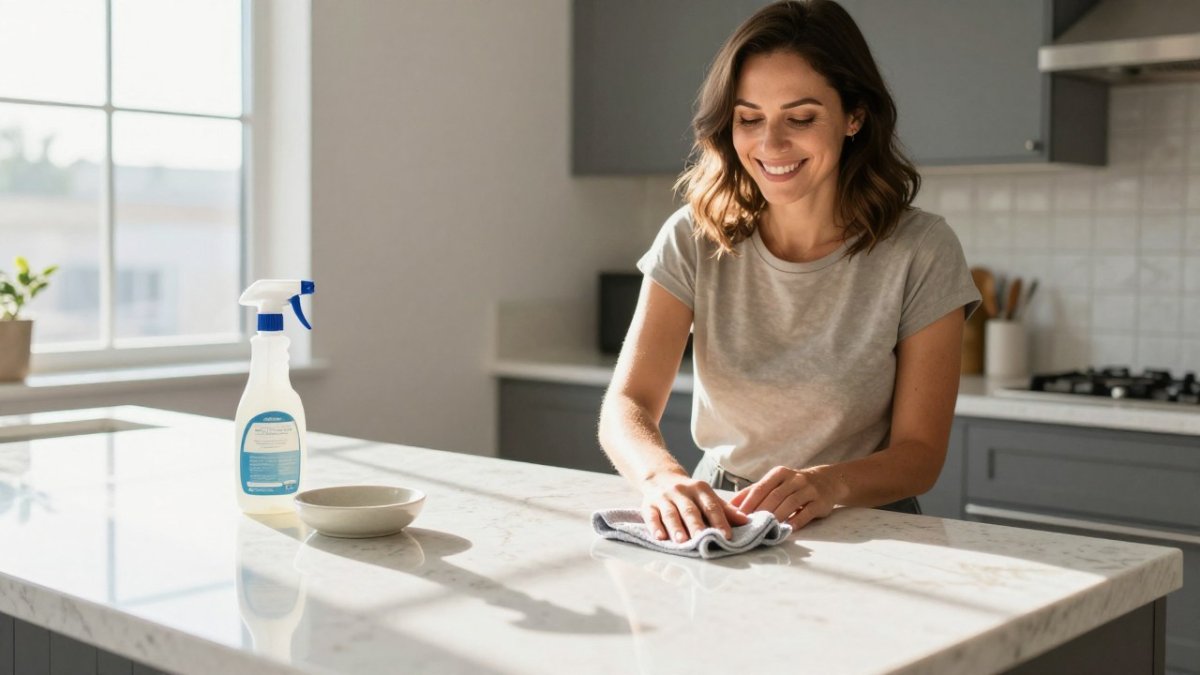
The best everyday cleaner for quartz countertops is a neutral pH spray used with a soft microfiber cloth.
Look for a countertop cleaner labeled safe for quartz that leaves no residue.
The label check matters. A "stone cleaner" is not automatically quartz-safe. Read the back for a neutral pH claim and a note that it is safe for engineered stone.
Best for: daily wipe-downs on kitchen islands and bathroom vanities. Skip if: the surface has a heavy grease film, which needs a degreasing step first.
The Best Disinfectant Cleaner for Quartz Countertops
The best disinfectant cleaner for quartz countertops sanitizes without leaving a film or requiring a harsh rinse. Quartz handles sanitizing well because it is non-porous.
That said, not every disinfectant belongs on quartz. Bleach-based sprays and anything labeled "acidic" can etch or dull the surface over time.
For raw meat prep: clean first with a neutral cleaner, then sanitize, then wipe with a damp cloth and dry.
Best for: households that prep raw chicken or fish on the counter. Skip if: you already clean with a quartz-safe daily spray and only need light sanitizing.
The Best Quartz Cleaner and Polish for Restoring Shine
The best quartz cleaner and polish for restoring shine is a mild, non-abrasive formula applied sparingly and buffed dry.
Shine loss on quartz usually comes from film buildup from the wrong cleaner or micro-scratches from abrasive pads. Polish addresses the first.
Apply a small amount to a microfiber cloth, work it in a circular motion over a small area, and buff until dry.
Best for: counters that look dull but are otherwise undamaged. Skip if: the haze comes from a chalky residue, which a proper rinse will fix for free.
Quartz Countertop Cleaners: What to Avoid and Why
Quartz countertop cleaners to avoid include acidic products, bleach-heavy sprays, abrasive creams, and anything with a scouring pad. These attack the surface rather than the soil.
Ingredients That Damage Engineered Stone
The resin binder in quartz gives it color and gloss. Strong acids, high-alkaline degreasers, and solvents can break that binder down over repeated use, leaving dull patches.
Keep these off the counter:
- Vinegar, lemon juice, and other acidic descalers
- Bleach-based sprays left to sit
- Oven cleaner and drain cleaner, even in small amounts
- Abrasive powders and cream cleansers
- Steel wool and scouring pads
For context on how much abuse quartz can take compared with natural stone, our quartz vs granite countertops durability guide covers what each surface handles well.
A Step-by-Step Routine for Daily Maintenance and Stain Removal
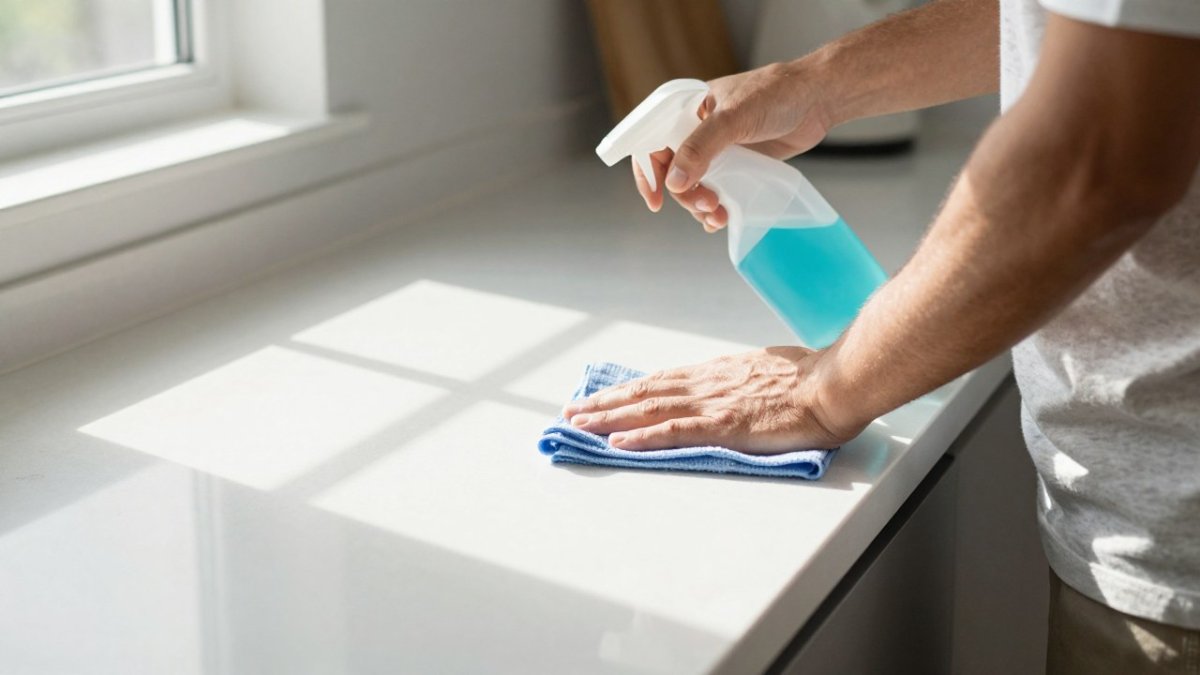
Daily maintenance takes about a minute: spray, wipe, dry. The dry step is the one people skip, and it is the one that prevents streaks and watermarks. Dried spills, hard-water rings, grease film, and cleaner buildup each need a different approach.
The Daily Routine
Here is a routine homeowners can follow:
- Clear loose crumbs with a dry cloth or soft brush.
- Spray a neutral quartz cleaner over the surface, not directly on seams.
- Wipe with a clean microfiber cloth, working in overlapping passes.
- Dry with a second cloth to a streak-free finish.
- Wipe up spills promptly, especially oil, wine, and tomato sauce.
- Once a month, check the surface under direct light for haze or film.
Troubleshooting by Mark Type
Not every mark is the same, and treating them alike is how people scratch a finish. Match the method to the mark:
- Dried food and sticky residue. Dampen a microfiber cloth with warm water, lay it over the spot for a minute to soften it, then wipe. Do not scrape with a blade or scrub with an abrasive pad.
- Grease film around the cooktop. Use a quartz-safe degreaser applied to the cloth rather than the counter, let it sit briefly, then rinse thoroughly with a damp cloth followed by a dry one.
- Hard-water rings and watermarks. A cloth dampened with plain water and a quartz-safe cleaner usually lifts them. If a ring persists, apply a mild polish sparingly to the ring only.
- Cleaner buildup and haze. A cloudy, streaky film usually means too much cleaner or a product never rinsed off. Wipe with a cloth dampened with plain water, then dry. If haze remains, switch to a lighter application rather than a stronger product.
- Oil and wine stains. Blot, do not wipe, to avoid spreading. Then clean with a neutral spray and dry. Prompt action matters more than product strength on non-porous quartz.
Adjust for Your Finish and Manufacturer
Polished quartz hides streaks better than matte or honed finishes, which show film and lint readily. On matte surfaces, use less cleaner and dry more thoroughly.
Watch out: repeated use of an acidic "natural" cleaner such as vinegar can dull the resin binder over months, and the damage shows up as a patchy sheen that no polish will fully restore.
For a deeper walkthrough of stain removal and long-term care, our quartz countertop maintenance guide expands on this routine step by step.
How to Choose Quartz Countertop Care Products for Sale
Choosing comes down to a repeatable comparison, not a brand name. Most product pages say a cleaner is "quartz safe" and stop there. Compare every bottle on the same five criteria.
The Five-Criteria Comparison
Use this framework on any cleaner, polish, or protector before you buy:
- Price per fluid ounce. Divide the bottle price by its size to compare options. Refills often cost less per ounce than single bottles.
- Ingredients and pH. A daily cleaner should state neutral pH and list no acids, no bleach, and no solvents. If the label hides ingredients behind "proprietary blend," keep looking.
- Intended use. Cleaner, polish, and protector are not interchangeable. A polish sold as a "3-in-1 cleaner and sealer" is usually a compromise that cleans poorly and leaves film.
- Scent and residue. Fragrance-heavy formulas can leave a lingering smell and a faint haze. Unscented or lightly scented options are safer for food-prep surfaces.
- Surface and finish compatibility. Matte and honed quartz show streaks and film more readily than polished surfaces, so a product that dries clear on gloss may look chalky on matte.
Cleaner, Polish, or Protector: A Decision Guide
The product type matters more than the brand. Here is how to decide which one you actually need:
- Buy a cleaner first. It handles 90% of daily care: grease, fingerprints, food splatter, and light stains. One neutral pH spray and a stack of microfiber cloths cover most kitchens.
- Add a polish only if the surface looks tired. Polish restores gloss on a dull but undamaged surface. It does not clean, and it should not be used more than monthly.
- Skip the protector unless your manufacturer calls for it. Many quartz makers advise against film-forming protectors because buildup causes haze.
- Treat disinfectant as a separate purchase. A quartz-safe disinfectant is worth having for raw meat prep, but it is not a substitute for a daily cleaner.
Check Your Manufacturer's Care Instructions First
Product compatibility varies by surface and finish. Before you buy anything, find the care sheet that came with your countertop or look up the fabricator's guidance. Some manufacturers publish approved cleaner lists; others specify only neutral pH soap and water. A bottle that says "safe for quartz" is a starting point, not a guarantee.
Watch out: a product marketed as a "quartz sealer" is usually unnecessary on non-porous engineered stone, and repeated use can leave a cloudy film that is harder to remove than the stains it was meant to prevent.
Match the Size to Your Habits
A 16 fluid ounce spray suits a single kitchen and fits under the sink. A 32 fluid ounce refill or concentrate makes sense if you clean daily or have more than one quartz surface.
If you are also weighing quartz for a bathroom, our guide on whether quartz is worth it for bathroom countertops explains whether the same products carry over.
If you want the wider picture on why engineered stone needs its own care, our quartz vs granite kitchen comparison lays out the differences in how each surface behaves.
Bring Your Countertop Questions to Our Showroom
Picking a cleaner is the easy part.
My Kitchen Design EXPO is a family-owned business serving Central Florida since 2009, with nearly 40 years of design experience behind our team.
If you are planning a kitchen or bath update, you can contact My Kitchen Design EXPO to learn more about your options.
Get started with My Kitchen Design EXPO and choose a countertop you will still love years from now.
Frequently Asked Questions
What is the best way to care for quartz countertops day to day?
Wipe the surface with a soft cloth and a neutral-pH cleaner after cooking, and clean up spills promptly so they do not set. Avoid abrasive pads, bleach-heavy products, and anything with a high acid content, which can dull the resin binder in engineered stone. A quick daily wipe plus a weekly deeper clean keeps the surface streak-free and protects the finish.
Can you use polish on quartz countertops?
Yes, a polish formulated for quartz can restore shine and help hide light surface haze, but it should not be used as a substitute for cleaning. Apply it after the counter is clean and dry, buff with a soft cloth, and use it sparingly. Heavy or frequent polishing is unnecessary and can leave residue that attracts dust.
Which disinfectant cleaners are safe for quartz countertops?
Look for disinfectants labeled safe for quartz or engineered stone, typically neutral-pH formulas without bleach or harsh solvents. Spray, let it sit for the dwell time on the label, then wipe dry to avoid watermarks. For food-prep areas, rinse with a damp cloth after disinfecting so no residue remains on the surface.
How often should you clean quartz countertops?
Wipe daily after food prep, do a fuller clean once a week with a quartz-safe cleaner, and disinfect high-touch zones like prep areas as needed. Deep cleaning for grease or stains is only necessary when you see buildup. Consistent daily maintenance prevents the residue and watermarks that make deeper cleaning necessary.